
Red-footed knight
Tricholoma basirubens
Description
Symptoms
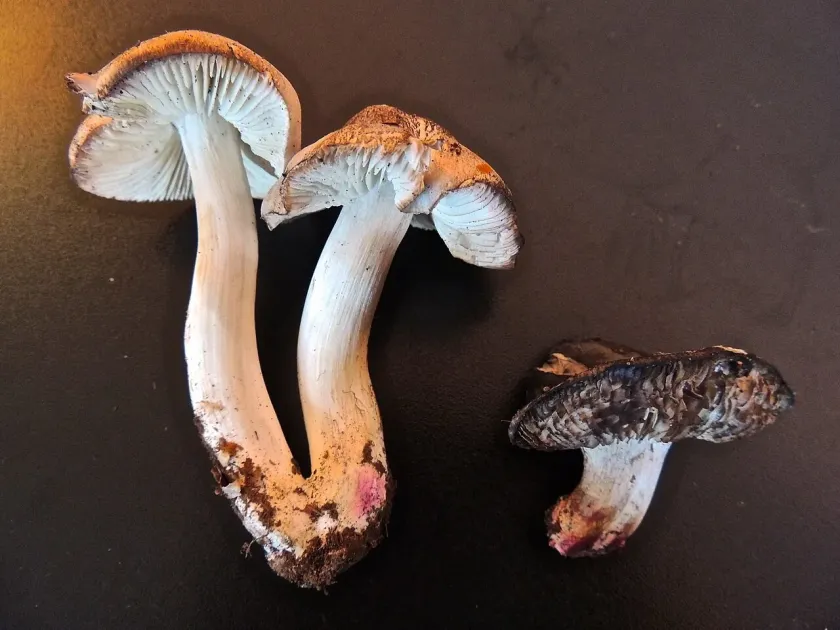
The red-footed knight (Tricholoma basirubens) is a gilled mushroom species within the Tricholomataceae family. It is distinct due to its specific coloration on the lower stem.
The cap typically reaches 3 to 8 cm in diameter. Young specimens feature a convex cap, which eventually flattens out, often retaining a small central umbo.
The surface of the cap is generally grayish-brown or brownish. The cap margins often remain incurved during the early stages of development.
The gills are adnate, varying in density, and are white or cream-colored, sometimes developing subtle dark spots as the fruit body matures.
The stem is solid and cylindrical, with a distinct red or wine-red pigmentation at the base, which serves as the primary diagnostic feature of this species.
Pathogen
It is crucial to clarify that Tricholoma basirubens is not a plant pathogen or a disease of crops. It is a saprotrophic or mycorrhizal fungus common in forest ecosystems.
As a basidiomycete, its life cycle involves mycelial growth in forest litter and the formation of fruit bodies for spore production.
Since the fungus does not parasitize agricultural plants, it poses no threat to orchards, field crops, or any form of agronomic production.
In phytopathological classifications, this species is not listed as a disease agent, as its ecological niche is strictly confined to natural forests.
The mycelium contributes to organic matter decomposition and maintains forest soil health, acting as an essential component of the ecosystem.
Conditions for development
The red-footed knight thrives in environments with humus-rich forest soils, typically found under coniferous or mixed woodland canopies.
Ideal conditions for fruit body emergence occur during late summer and autumn, provided there is consistent humidity and moderate temperatures.
The fungus is responsive to soil moisture levels, with heavy rainfall often triggering the development of fruiting bodies from established mycelia.
Temperature ranges between 12 and 18 degrees Celsius are considered optimal for the biological activity of the fungus.
The preservation of natural forest litter is essential for the sustained presence of this species in its natural habitat.
Why it matters
As previously mentioned, Tricholoma basirubens causes no damage to cultivated plants. It is not a pest, and thus the term 'harm' is not applicable in an agricultural context.
The fungus does not induce root rot, leaf spots, or any other physiological disorders in crop plants.
Its lack of interaction with agricultural land makes it a neutral organism for farmers and growers.
There are no recorded economic losses associated with this mushroom, and it requires no monitoring or management in agrarian settings.
The ecological impact of the fungus is beneficial, aiding in nutrient cycling within wild environments.
Protection
No protective measures are required for this fungus, as it is not a plant pathogen and does not necessitate any management practices.
Agronomic guidelines do not include control strategies against this species, given its lack of threat to agricultural crops.
Applying fungicides to control this species is illogical and lacks any economic justification, as it would disrupt the beneficial mycobiota.
Preventive measures are not developed due to the non-pathogenic nature of Tricholoma basirubens.
Any attempt to remove the fungal mycelium would be an unnecessary interference with the local ecosystem and would provide no agricultural benefit.
Discussion
No discussions yet — be the first.