
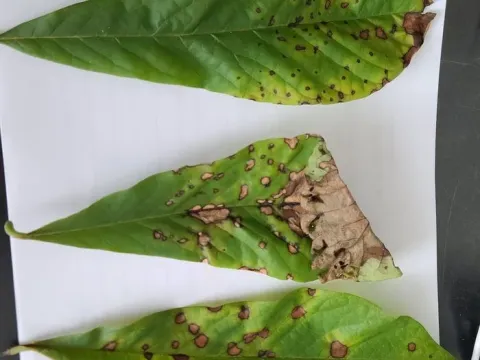
Loquat Phyllosticta leaf spot
Phyllosticta eriobotryae
The initial symptoms of Phyllosticta leaf spot on loquat trees appear as small, circular or irregular lesions on the leaf surface. These spots are typically brown or reddish-brown and are often surrounded by a darker border.
What the section contains
Loquat Phyllosticta leaf spot
As the infection progresses, these spots expand in size, and their centers often turn gray or ash-colored. Eventually, the necrotic tissue may dry out and crack, leading to leaf distortion and premature leaf drop.
Tiny black dots, known as pycnidia, frequently form within the center of these lesions. These structures are the reproductive bodies of the fungus and contain the spores responsible for spreading the infection to healthy tissue.
The disease often starts in the lower parts of the canopy and gradually moves upwards. Under favorable conditions, the infection can also spread to leaf petioles and young, succulent shoots.
While this disease shares visual similarities with other leaf spot conditions, the presence of these characteristic black pycnidia under magnification is a key diagnostic feature for confirming the infection.
The causative agent of this disease is the fungi Phyllosticta eriobotryae, which belongs to the order Sphaeropsidales. It is a specialized parasite primarily affecting plants within the Rosaceae family.
The fungus survives the winter as mycelium and pycnidia on fallen, infected leaves remaining in the orchard. Primary infection typically occurs in the spring when temperatures rise sufficiently.
Spore dispersal is facilitated by rain splashes, wind, and insect activity. Once the conidia land on a healthy leaf, they germinate and penetrate the epidermal layer, beginning the destruction of plant cells.
The incubation period for the disease is heavily influenced by temperature and moisture levels. High humidity significantly shortens this cycle, allowing the fungus to reproduce rapidly and spread throughout the canopy.
The pathogen's biology is closely linked to the tree's health; a weakened immune system due to poor site conditions or prior pest damage makes the plant significantly more susceptible to successful colonization.
The development of loquat Phyllosticta leaf spot is closely tied to periods of high humidity and frequent rainfall. Water droplets on the leaf surface are essential for the germination of fungal spores.
The optimal temperature range for the spread of this infection is between 18 and 25 degrees Celsius. Within this window, the fungus is most aggressive in colonizing healthy plant tissue.
Dense, poorly pruned tree canopies create a microclimate with stagnant air and high moisture levels. This prevents leaves from drying out quickly after rain or irrigation, favoring the pathogen.
Poor orchard management, such as the lack of proper pruning and sanitation, increases the risk of outbreaks. Areas with high planting density are particularly prone to rapid disease transmission.
Imbalanced nutrient supply, specifically excess nitrogen coupled with potassium and phosphorus deficiencies, can lead to softer leaf tissues, making it easier for fungal hyphae to penetrate the leaf barrier.
The primary damage caused by this disease is the reduction of the photosynthetic leaf area. As leaves become covered with lesions, the tree's ability to produce energy through photosynthesis is significantly hampered.
Premature leaf drop exhausts the tree's energy reserves before winter. This makes the loquat tree less resilient to cold temperatures and frost, potentially leading to branch dieback or reduced winter hardiness.
The disease also affects fruit quality and yield. Infected trees may produce smaller, malformed fruits with poor flavor, and in severe cases, the fruit itself may be impacted by the pathogen.
Long-term exposure to the disease can lead to the gradual decline of skeletal branches. If left unmanaged, the tree may lose its productivity and structural integrity over several growing seasons.
The loss of aesthetic value is also a significant concern, especially for loquat trees planted for ornamental purposes, as the spotted and falling foliage detracts from the tree's natural appearance.
The most important cultural control method is the thorough collection and destruction of all fallen leaves in the autumn. This significantly reduces the primary inoculum source for the following season.
Regular pruning is essential to improve air circulation within the canopy. By opening up the tree structure, leaves dry faster, making conditions less favorable for fungal growth and sporulation.
- Apply 1% Bordeaux mixture spray during the early spring.
- Use copper-based fungicides immediately upon the first signs of spotting.
- Incorporate systemic fungicides to inhibit internal mycelial growth.
- Ensure balanced fertilization with potassium to strengthen plant tissue resistance.
A successful chemical protection program requires multiple applications at 10 to 14-day intervals. It is recommended to rotate different classes of fungicides to prevent the pathogen from developing resistance.
Avoid overhead irrigation, as water spray mimics rainfall and aids spore dispersal. Utilizing drip irrigation or soil-level watering helps maintain dry foliage and minimizes the risk of spreading the fungus.