
Loxospora
Loxospora
Description
Symptoms
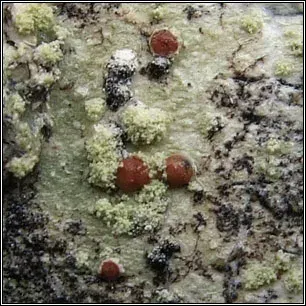
The primary symptom of Loxospora is the development of crust-like patches on the bark, which can appear greyish, greenish, or white, depending on local conditions.
Characteristic signs include small, brightly colored apothecia (fruiting bodies), which look like tiny discs or cups scattered across the thallus of the lichen.
These lichen patches tend to colonize the shaded, north-facing side of tree trunks and major branches, where moisture persists the longest after rain.
The bark surface under the colony may appear slightly roughened, but unlike fungal infections, the tissue beneath remains firm and healthy.
When examined closely, the growth is superficial and can be scraped off easily, which is a key diagnostic feature distinguishing it from deep-seated plant diseases.
Pathogen
Loxospora is a genus of crustose lichens, which are complex organisms involving a symbiotic relationship between a fungus and algae. In agricultural terms, they are often mistaken for tree diseases, but they are not parasitic.
These organisms do not extract nutrients from the tree's sap or damage the underlying wood tissue. Instead, they use the bark purely as a stable surface for attachment.
The most common representative is Loxospora elatina, which thrives in environments with high ambient humidity, frequently observed in older or neglected orchards and forest margins.
Biologically, these are not pathogens in the sense of causing necrosis or rot. They belong to the family Ramalinaceae and serve as an ecological indicator of the surrounding climate.
While they are not traditional disease agents, their presence can influence the micro-environment of the bark, requiring attention from orchard managers.
Conditions for development
Loxospora requires high relative humidity to grow, making it common in regions with frequent rainfall, fog, or proximity to water bodies.
Poor orchard sanitation and overly dense canopies contribute to their development by limiting airflow, which prevents the bark from drying out efficiently.
Air quality is a critical factor, as these lichens are highly sensitive to pollution; their presence often indicates a clean and stable atmospheric environment.
Older trees with thick, fissured bark provide more surface area and shelter for the lichen to establish, explaining why it is most prevalent in mature orchards.
Moderate temperatures throughout the growing season provide the ideal balance for the metabolic processes of the lichen and its algal partner.
Why it matters
Loxospora does not cause direct harm to trees because it does not consume host tissues or release toxins that inhibit plant growth.
The indirect risk lies in the lichen's ability to act as a harbor for overwintering pests, such as mites, aphids, or scales, which may hide beneath the lichen crust.
While it does not feed on the tree, heavy accumulation may reduce the natural gas exchange of the bark, causing the tree to be less responsive to environmental stress.
The dense cover of lichen can mask early symptoms of actual tree diseases or physical wounds, hindering early detection of health issues.
For high-value commercial orchards, the presence of excessive lichen is considered a sign of poor maintenance, which can impact the overall vigor of the stand.
Protection
The most effective management strategy is regular physical cleaning of trunks and main branches using a stiff brush or a specialized scraper during the dormant season.
Pruning is the best preventative measure: by thinning the canopy, you improve light penetration and air circulation, creating a drier environment that deters lichen growth.
Whitewashing the trunk with lime-based mixtures is a traditional and highly effective way to sanitize the bark and inhibit the re-establishment of lichen colonies.
Applying copper-based fungicides as part of a regular spray program can also reduce lichen populations while simultaneously controlling other common fungal issues.
Ensuring optimal tree nutrition and hydration helps maintain robust bark vitality, which naturally limits the colonization of the surface by opportunistic lichens.
Discussion
No discussions yet — be the first.