
Phoma stem canker
Phoma sublingam
The disease is caused by the fungus Phoma lingam (teleomorph: Leptosphaeria maculans). It affects various brassica species, primarily oilseed rape (canola), cabbage, cauliflower, and mustard.
What the section contains
Phoma stem canker
The pathogen survives on infected crop residues in the soil and can be seed-borne. It spends a significant part of its life cycle as a saprophyte on stubble, where it produces pseudothecia that release ascospores.
The infection cycle consists of a sexual phase, producing wind-borne ascospores, and an asexual phase, producing rain-splashed conidia. Both spore types can initiate infections under favorable environmental conditions.
The fungus exhibits high genetic diversity, which allows it to overcome resistant traits in cultivars. Different races of L. maculans vary in aggressiveness, complicating the breeding process for resistance.
Once inside the plant, the fungus grows through the intercellular spaces and colonizes the vascular system, leading to systemic necrosis of the stem tissue.
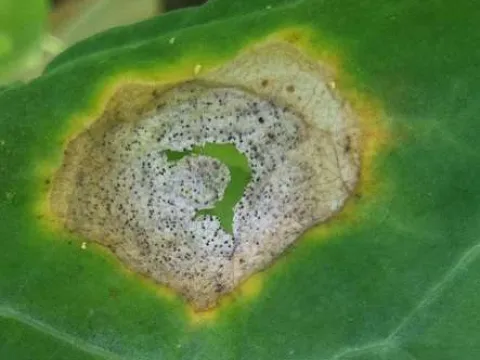
Early symptoms appear as pale, grayish-white leaf spots with numerous small black dots, known as pycnidia. These spots are often irregular in shape and may have a dark margin.
The most critical symptom is the canker at the stem base (crown). The tissue becomes necrotic, woody, and may crack. This girdling of the stem prevents the movement of water and nutrients.
In mature plants, the internal tissue of the stem base shows a characteristic dark, dry rot. This decay weakens the plant, often causing it to lodge or snap off completely at the base.
Pod infection can also occur, resulting in circular, dark lesions. These lesions cause pods to shatter prematurely, leading to significant seed loss before harvest begins.
A diagnostic feature during humid weather is the visibility of black pycnidia arranged in concentric circles within the necrotic tissue of leaves or stem lesions.
The development of Phoma stem canker is favored by moderate temperatures (15-20°C) and high humidity. Frequent rainfall facilitates the spread of spores from crop debris to the canopy.
Infection is most aggressive when weather conditions are wet during the leaf-development stage and during the flowering period, when pods are susceptible to fungal colonization.
Continuous cropping or short rotations of brassica crops lead to the accumulation of inoculum in the field, making it difficult to control the disease using standard methods.
Insect damage, such as feeding by flea beetles or cabbage root flies, creates entry wounds in the plant, which are rapidly colonized by the pathogen, increasing the disease severity.
Poor field drainage and excessive plant density create a microclimate with high relative humidity, which promotes the germination of fungal spores on plant surfaces.
Phoma stem canker is a major disease of oilseed rape globally. Severe infections lead to lodging, which significantly complicates the harvesting process and increases field losses.
The blockage of the plant's vascular system leads to stunted growth, reduced pod filling, and a decrease in the thousand-seed weight and overall oil content of the grain.
In highly susceptible cultivars, the disease can cause total crop failure. Even in moderate cases, the economic impact is high due to reduced yields and inferior seed quality.
The reliance on chemical control adds significant costs to crop production. Furthermore, infected seeds pose a risk of introducing the disease to new regions or disease-free fields.
Systemic colonization of the plant results in premature senescence, depriving the crop of the necessary time for optimal maturation and seed yield accumulation.
Effective management requires a multi-faceted approach, starting with a crop rotation that leaves at least 3-4 years between brassica crops to allow for the decomposition of infected residues.
The selection of resistant cultivars is the primary defense strategy. Using certified, disease-free seed that has been professionally treated with fungicides helps prevent early-season infections.
Cultural practices, including deep tillage to bury crop residues, help accelerate the degradation of the fungal fruiting bodies and reduce the primary source of inoculum.
Fungicide applications are recommended during the rosette stage and early flowering if weather conditions are conducive to infection and scouting reveals early symptoms.
- Utilize resistant oilseed rape hybrids.
- Implement at least a 3-4 year crop rotation.
- Use high-quality fungicidal seed treatments.
- Control brassica weeds that act as alternative hosts.
- Manage insect pests to prevent injury to plant stems and leaves.