
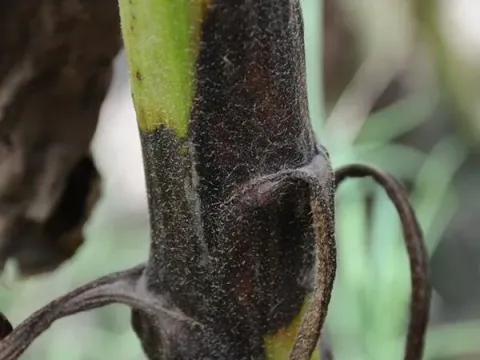
Phoma black stem
Plenodomus lindquistii
The causative agent of the disease is the fungus Plenodomus lindquistii (formerly known as Phoma macdonaldii). It is a major fungal pathogen affecting various crops.
What the section contains
Phoma black stem
While the pathogen primarily infects sunflower (Helianthus annuus), it can also be found on Jerusalem artichoke, which serves as a host for its survival.
The fungus overwinters in soil as pycnidia and mycelium on infected crop debris, making it a persistent threat in fields where sunflowers are grown repeatedly.
During the growing season, the pathogen produces conidia, which are disseminated by rain splash, wind currents, and insect activity to healthy plant tissues.
The fungus is capable of persisting in the soil for several years, necessitating careful field management to break the cycle of infection and inoculum buildup.
Early symptoms appear as dark brown or black lesions on the cotyledons and the lower leaves of young sunflower plants.
Lesions on leaves often exhibit a characteristic concentric zonation and may be surrounded by a chlorotic halo as the fungus spreads into the tissue.
As the disease progresses, large black lesions develop on the stem, particularly at the leaf axils or near the base of the plant, weakening the structure.
The epidermis of the stem often becomes thin and papery, and tiny black spots, representing the pycnidia, become visible within the discolored lesions.
In severe cases, the fungal infection causes the stem to soften and collapse, leading to premature wilting and death of the entire plant.
Warm and humid weather conditions are highly favorable for the development of Phoma black stem, especially when temperatures range from 20°C to 25°C.
Frequent rainfall events during the early stages of plant development trigger the release and spread of spores, facilitating primary infection.
High plant population density restricts airflow within the canopy, creating a localized humid microclimate that promotes rapid fungal colonization.
Excessive nitrogen fertilization can lead to succulent growth, making the plant tissues more susceptible to fungal penetration and rapid lesion expansion.
Mechanical injuries to the stem caused by insects, such as the sunflower stem weevil, create entry points for the pathogen and accelerate disease progression.
Phoma black stem can significantly reduce crop yields, with potential losses ranging from 20% to 50% under conditions conducive to disease.
The disease reduces the filling of seeds, resulting in lower oil content, decreased thousand-kernel weight, and overall poor seed quality.
Stem weakening caused by the fungus leads to severe lodging, which hinders mechanical harvesting and increases yield losses in the field.
The destruction of leaf tissue reduces photosynthetic capacity, impairing the plant's ability to fill the head properly during the grain-filling stage.
Severe infestations can lead to premature senescence of the entire crop, drastically shortening the growing season and negatively impacting financial returns.
Implementing a long-term crop rotation, avoiding sunflowers in the same field for at least 6–8 years, is the most effective cultural control strategy.
Deep plowing of crop residues immediately after harvest helps bury and decompose infected debris, reducing the initial inoculum levels in the soil.
Using certified, fungicide-treated seeds and selecting resistant or tolerant hybrids is critical for mitigating the risk of early-season infections.
Foliar application of fungicides at the V4 to V6 leaf growth stages can help protect the stem and prevent the rapid spread of the pathogen.
Integrated pest management to control stem-boring insects helps maintain plant integrity and minimizes entry points for the fungal pathogen.