
Phoma disease
Boeremia inoxydabilis
Description
Symptoms
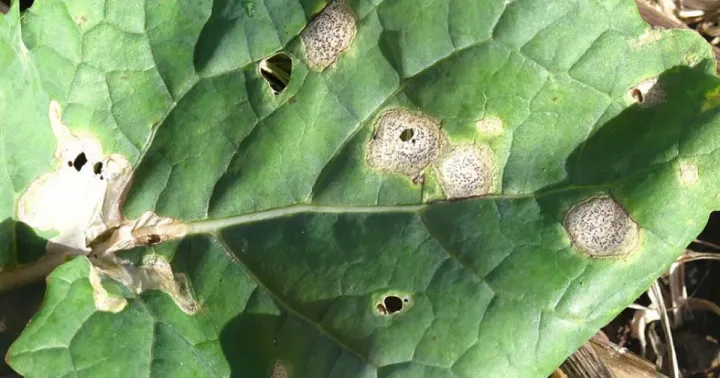
Initial symptoms of Phoma disease appear as necrotic spots on leaves and stems. These lesions typically exhibit an irregular shape and a greyish-brown color, often framed by a distinct yellowish halo.
A definitive diagnostic feature is the presence of numerous minute, black, pimple-like structures known as pycnidia scattered across the necrotic tissue. These are usually visible to the naked eye or with a low-power magnifying lens.
Stem infections frequently lead to collar rot, where the base of the stem becomes discolored and softened. This structural failure often results in plant lodging and rapid wilting of the foliage above the infection point.
In the root zone, the infection causes browning and tissue necrosis, which severely impairs the plant's nutrient and water uptake. Infected roots become fragile, leading to stunted overall growth.
Infected fruit or pods may develop depressed, dark lesions that eventually cover the surface. These spots are often covered with a mass of spores during wet weather, further contaminating the surrounding area.
Pathogen
The causative agent of the disease is the fungus Boeremia inoxydabilis, belonging to the Ascomycota phylum. Previously categorized within the Phoma genus, it has been taxonomically revised to the Boeremia genus based on modern genomic analysis.
The pathogen persists in the soil on infected crop residues and can also be transmitted via infested seeds. Pycnidia, which are the fungal fruiting bodies, act as dormant survival structures capable of remaining viable for several growing seasons.
The life cycle involves the production of pycnidiospores within the pycnidia. When environmental moisture is high, these spores are released and disseminated by rain splashes and wind currents onto susceptible plant tissues.
Infection is initiated when spores germinate on the host surface, allowing the mycelium to penetrate the plant epidermis. Once inside, the fungus spreads through the vascular system and parenchyma, secreting enzymes that degrade plant cell walls.
This fungus exhibits a broad host range, infecting various field and vegetable crops. It primarily targets stressed or physiologically weakened plants, although it can successfully invade healthy tissues under conducive environmental conditions.
Conditions for development
Development of Boeremia inoxydabilis is highly dependent on humidity and temperature. Favorable conditions include moderate temperatures (18–25°C) combined with high relative humidity or frequent rainfall.
Periods of prolonged leaf wetness are essential for successful spore germination and infection. Rain splash is a primary mechanism for the localized spread of the disease within a field canopy.
High planting density contributes to the rapid progression of the disease by creating a closed, humid microclimate near the soil surface. This reduces airflow and keeps plant surfaces wet for extended periods.
Inadequate soil fertility, particularly low potassium and calcium levels, often makes crops more susceptible to invasion. Nutritional stress limits the plant's ability to trigger natural defense mechanisms against fungal enzymatic attack.
Mechanical damage from agricultural equipment, insects, or environmental factors provides easy access for the fungus to penetrate internal plant tissues, bypassing natural cuticle defenses.
Why it matters
The economic impact of Phoma disease is primarily driven by the reduction of green leaf area, which limits photosynthetic efficiency. This leads to reduced biomass accumulation and inferior crop quality.
Stem girdling significantly restricts water and nutrient transport, causing premature senescence and plant death. This disruption often results in yield losses ranging from 20% to 50%, depending on the timing of the infection.
Infected crops often produce lighter, shriveled seeds with poor germination rates. Such seeds serve as inoculum sources, ensuring that the pathogen is reintroduced into the field during the subsequent planting cycle.
Beyond quantity, Phoma disease degrades the quality of the harvested produce. It may lead to undesirable flavor profiles or contamination by fungal metabolites, making the crop unsuitable for processing or storage.
Field management costs increase significantly when protective fungicide applications are required to manage the spread, negatively impacting the overall profitability of the agricultural operation.
Protection
Integrated Pest Management (IPM) is the most effective approach to managing Phoma disease. It emphasizes a combination of preventive agricultural practices and targeted chemical interventions.
Selecting and planting resistant or tolerant cultivars is the primary defense strategy. Genetic resistance can drastically reduce the severity of the infection and maintain yield levels under disease pressure.
Implementing crop rotation is crucial for breaking the disease cycle. Rotating away from susceptible hosts for at least 3–4 years allows the soil-borne inoculum to naturally decline.
Proper residue management, including deep tillage or biological degradation treatments, helps bury the infected material and accelerates its decomposition, thereby reducing the available source of spores.
- Use of high-quality, fungicide-treated certified seeds.
- Maintenance of balanced soil fertility to strengthen plant defenses.
- Strategic application of foliar fungicides based on disease forecasting.
- Rigorous weed control to remove alternative hosts for the pathogen.
Discussion
No discussions yet — be the first.