
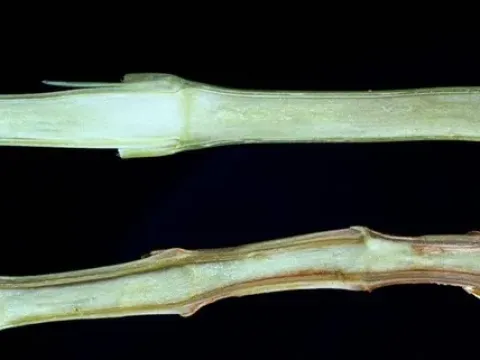
Phialophora wilt
Phialophora
Phialophora wilt is a fungal disease caused by various species of the genus Phialophora. These fungi are soil-borne pathogens that can persist in the soil for several years by utilizing organic matter or surviving as dormant mycelium or spores.
What the section contains
Phialophora wilt
The fungus acts as a vascular pathogen, colonizing the plant's xylem tissue. Once inside, the fungal mycelium grows and produces toxins, which disrupt the water-conducting vessels and impede the transport of water and nutrients from the roots to the shoots.
These fungi reproduce primarily through the formation of conidia on specialized structures called phialides. These spores are easily disseminated by irrigation water, contaminated equipment, or movement of infested soil particles.
The life cycle of Phialophora allows it to thrive in both live plant tissues and decaying debris. This flexibility makes it a resilient pathogen that is difficult to eradicate once it has become established in an agricultural area or a greenhouse environment.
A wide range of plant species are susceptible to this pathogen, including various vegetables, carnations, and woody ornamentals. Its ability to infect diverse hosts makes it a persistent threat in both commercial crop production and landscaping.
The initial symptoms of Phialophora wilt are often subtle, starting with wilting or chlorosis of the lower leaves. This yellowing typically progresses upwards, leading to gradual defoliation as the plant struggles to maintain water uptake.
A key diagnostic feature of this disease is the internal discoloration of the stem tissue. When infected stems or roots are cut transversely, one can observe brown or reddish-brown streaks in the vascular bundles, indicating blockage by the fungal mass.
As the infection advances, the plant growth becomes stunted, and the symptoms become more severe. In many cases, the plant may die rapidly once the vascular system is completely occluded, showing no recovery even after adequate watering.
In humid conditions, some Phialophora species may show slight sporulation on the stem surface near the base, although this is not always visible. The primary damage remains internal, making the disease harder to identify without dissection.
Infection often occurs in clusters, spreading from one plant to its neighbors through the root zone. This pattern of patchy wilting in a field or greenhouse bench is a common indication that a soil-borne vascular pathogen is present.
The development of Phialophora wilt is strongly influenced by environmental conditions, particularly high soil moisture. Excess water facilitates the movement of fungal spores and favors their colonization of the root system.
Moderate temperatures, generally between 18°C and 25°C, are ideal for the rapid growth and spread of the pathogen. Under these conditions, the fungus can quickly traverse the host's vascular system, leading to systemic infection.
Mechanical damage to roots during transplanting or cultivation creates entry points for the fungus. These wounds allow the pathogen to bypass natural plant defenses and initiate colonization of the plant's internal tissues.
Infested soil or non-sterile growing media are the most common sources of initial outbreaks. Furthermore, the practice of monoculture creates a build-up of inoculum in the soil, significantly increasing the risk of infection in subsequent seasons.
Poor soil aeration and lack of drainage exacerbate the issue, as stressed roots are more vulnerable to the invasion of Phialophora species compared to healthy, well-developed root systems.
Phialophora wilt poses a significant threat to agricultural productivity. The systemic nature of the infection means that once a plant is colonized, it is usually impossible to save, leading to the total loss of the crop in infected areas.
The economic impact is particularly high in greenhouse industries, where the cost of removing infected plants, replacing the growing media, and disinfecting the facilities can be substantial.
The disease reduces the vigor and quality of the affected plants, rendering them unsuitable for sale. Even if some plants survive, their growth is severely impaired, resulting in a loss of yield and market value.
The persistence of the fungus in the soil complicates long-term management strategies. Fields or greenhouses affected by the disease may become unsuitable for susceptible crops for several years, requiring expensive sterilization.
The pathogen's ability to infect multiple hosts creates difficulties in crop rotation planning, as many common agricultural plants may serve as secondary hosts, maintaining the inoculum in the soil for extended periods.
Effective management begins with strict phytosanitary practices. The use of disease-free planting material and sterilized substrates is essential to prevent the introduction of Phialophora into the growing environment.
Implementing a proper crop rotation strategy is vital for breaking the disease cycle. Rotating susceptible plants with non-host species helps reduce the levels of pathogen inoculum in the soil over time.
Biological control agents, such as species of Trichoderma, can be applied to the soil to act as antagonists to Phialophora. These beneficial fungi compete for space and nutrients, effectively suppressing the growth of the pathogen.
Removing and destroying infected plant material, including the root ball, is necessary to minimize the spread of the pathogen to neighboring plants. Tools should be disinfected regularly to prevent cross-contamination.
- Ensure optimal soil drainage to prevent waterlogging.
- Monitor plants regularly for early signs of vascular wilting.
- Avoid over-fertilizing with nitrogen, as it creates soft, susceptible tissues.