
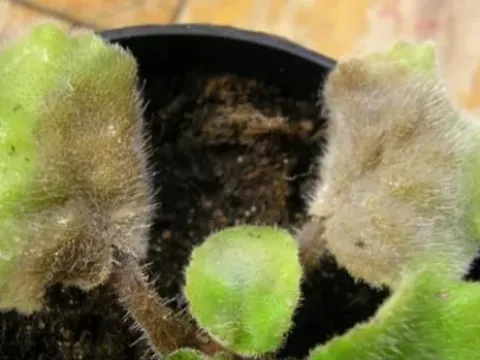
Downy mildew of violet
Peronospora violae
Initial symptoms of downy mildew appear as chlorotic, yellowish spots on the upper surface of the violet leaves, which eventually turn necrotic or brown.
What the section contains
Downy mildew of violet
A distinct grayish or purplish fuzz, consisting of fungal sporangia, develops on the underside of the leaves directly beneath the symptomatic spots.
Affected leaves tend to wilt rapidly, lose their turgor, curl along the margins, and eventually wither and drop prematurely from the plant.
In severe infections, the lesions expand and coalesce, leading to large burnt-looking areas that can engulf entire leaves and petioles.
Flowering is typically stunted or halted; flower buds may fail to open or become distorted, significantly diminishing the aesthetic value of the plant.
The causative agent is the oomycete Peronospora violae, a host-specific pathogen that targets various species within the Viola genus.
It is classified as a downy mildew, a type of plant disease that thrives exclusively in the presence of free water or high humidity on foliage.
The pathogen survives the off-season as oospores within soil, infected plant debris, or within the tissues of perennial plants in latent states.
The life cycle involves the production of sporangia that are dispersed by wind, splashing water from irrigation or rain, and contact with contaminated gardening tools.
Once landing on a host leaf, the fungus germinates and penetrates through the stomata, establishing a vegetative mycelium that drains nutrients from the plant host.
High relative humidity, typically above 80–90%, combined with cool to moderate temperatures ranging from 15°C to 20°C (59–68°F), triggers active disease development.
Conditions that promote long-lasting leaf wetness, such as morning dew or condensation due to temperature fluctuations, provide ideal environments for spore germination.
Overcrowded planting arrangements restrict air circulation, creating microclimates where humidity remains trapped, which accelerates the spread of the pathogen.
Overhead irrigation is a primary driver of infection, as it actively spreads spores between plants and maintains a constant film of water on the leaf surfaces.
Poor sanitation, such as failing to remove fallen leaves, creates a persistent reservoir of inoculum that reactivates whenever weather conditions become favorable.
Downy mildew causes profound metabolic stress by damaging chlorophyll-rich leaf tissues, which severely limits the plant's photosynthetic capacity.
If left untreated, the disease spreads rapidly throughout the canopy, potentially leading to the death of the entire plant within a matter of weeks.
Weakened plants are highly susceptible to secondary infections from opportunistic bacteria and fungi, which further complicates the recovery process.
For commercial growers, this disease poses a major financial threat, often resulting in the total loss of marketable stock and increased management costs.
The rapid dispersal of spores makes it a dangerous epidemic disease that can decimate greenhouse violet populations if containment measures are not strictly followed.
Immediate removal and destruction of symptomatic leaves or entire severely infected plants are essential to reduce the source of inoculum.
Cultivation practices must prioritize bottom-watering to keep foliage dry and ensuring adequate spacing to promote efficient airflow and leaf drying.
The application of systemic fungicides, specifically those containing metalaxyl or fosetyl-aluminum, is necessary to combat active infestations.
Preventive sprays with biological control agents like Bacillus subtilis can provide significant suppression of the pathogen under moderate risk conditions.
Comprehensive hygiene, including the disinfection of pots and benches and the use of sterile potting media, is critical to preventing the recurrence of the disease.