
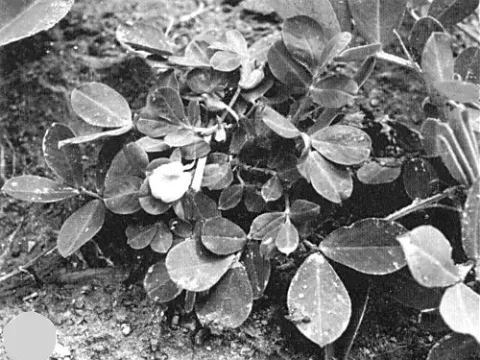
Peanut clump
Peanut clump
The primary symptom of Peanut clump disease is severe stunting of the host plants. Infected peanuts exhibit shortened internodes, resulting in a compact, dwarfed appearance that clearly distinguishes them from healthy plants.
What the section contains
Peanut clump
Leaf discoloration is a hallmark of the infection. Plants typically show chlorosis, yellowing, or a distinct mosaic pattern on the leaves, which significantly hampers their photosynthetic capacity and overall health.
Root system development is often impaired in diseased plants. Examination may reveal stunted root growth, necrotic lesions on secondary roots, and a reduced capacity for nutrient and water uptake from the soil.
When the virus affects sorghum, it manifests as mosaic patches or linear streaks on the leaves. Infected plants become weak and are often incapable of producing healthy, fully developed grain heads.
Field-level symptoms often appear in patches rather than uniformly across the entire crop. This patchy distribution is a direct result of how the soil-borne vector moves through the soil horizon.
The disease is caused by the Peanut clump virus (PCV), which is the type species of the Pecluvirus genus. It is a virus with a segmented single-stranded RNA genome.
PCV is a classic soil-borne virus. It does not spread through mechanical transmission or seed in a typical way; rather, it relies on specific soil-dwelling organisms for its survival and transmission.
The main vectors of the virus are plasmodiophorid protists, specifically Polymyxa graminis. These organisms act as carriers, housing the virus particles in their resting spores within the soil.
The persistence of the pathogen in the soil is exceptionally high. The resting spores of the vector can remain infectious for many years, making it difficult to eradicate the virus from the field.
The host range of PCV is broad, including both legumes like peanuts and various grasses such as sorghum. This diversity of hosts allows the virus to maintain its presence in diverse agricultural ecosystems.
The disease development is heavily dependent on soil conditions that favor the vector. High soil moisture, especially during the early stages of crop growth, promotes vector activity and subsequent infection.
Temperatures play a critical role in the transmission process. Warm soil temperatures facilitate the mobility of the vector's zoospores, allowing them to encounter and penetrate the root hairs of host plants.
Soil texture is a major factor in the spread of Peanut clump. Coarser, well-draining yet moist soils are often associated with higher infection rates, as they facilitate the movement of zoospores.
Poor agricultural practices can exacerbate the problem. Continuous cropping of susceptible varieties without adequate rotation leads to an accumulation of viral inoculum in the soil over consecutive seasons.
Movement of contaminated soil is another significant factor. Agricultural machinery or equipment moving from infested fields to clean areas can easily transport infected soil particles and vectors.
The economic impact of Peanut clump is substantial. In heavily infested fields, yield losses in peanuts can be catastrophic, often rendering a crop unproductive and economically unviable to harvest.
The quality of the final product is also severely compromised. Harvested pods are frequently small, shriveled, and have significantly reduced oil content, making them unacceptable for quality market standards.
For sorghum, the infection reduces the overall grain yield and nutritional value. The plants fail to develop healthy panicles, leading to a marked decrease in total biomass and forage quality.
The disease is particularly challenging due to its long-term impact. Once a field is infested, the pathogen remains a limiting factor for subsequent plantings, requiring long-term management strategies.
Because the virus attacks the root system early in the plant's lifecycle, the overall resilience and vigor of the crop are compromised, making the plants more susceptible to other stressors.
The most effective management strategy is the deployment of resistant cultivars. Breeding for resistance to the Peanut clump virus provides the most sustainable and cost-effective approach for farmers.
Crop rotation is essential for managing soil-borne inoculum. Planting non-host species disrupts the cycle of the vector and forces a decline in the concentration of the virus in the soil.
- Sanitizing farm equipment between fields to prevent the movement of contaminated soil.
- Eliminating weed species that may act as reservoirs for the virus or the vector.
- Adjusting planting dates to minimize the overlap between peak vector activity and the most vulnerable stage of crop growth.
Chemical control, such as the use of soil fumigants or nematicides, is generally not practical on a large scale due to high costs, environmental toxicity, and regulatory restrictions.
Implementing a rigorous monitoring program helps identify infestation hotspots. Early detection allows for localized management, preventing the spread of the virus to unaffected areas of the farm.