
Peanut didymella blight
Didymella arachidicola
Description
Symptoms
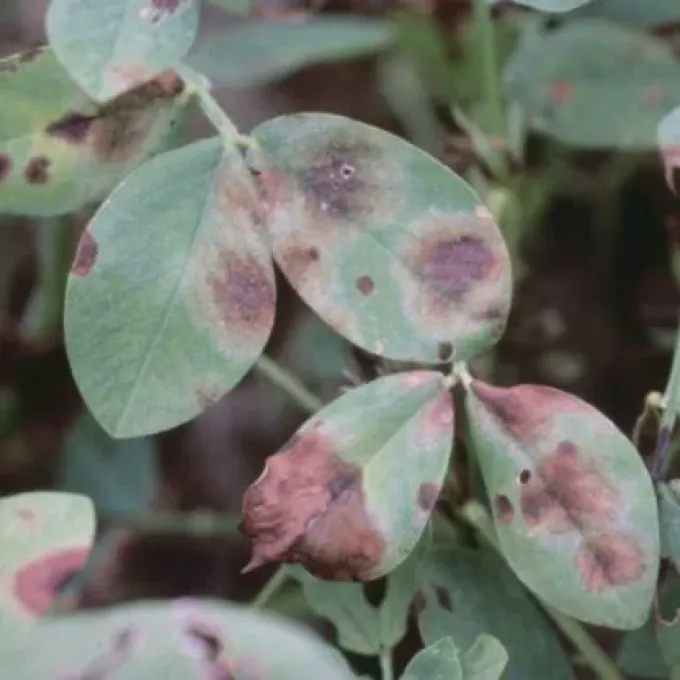
The most distinctive symptom of didymella blight is the formation of necrotic spots on the leaves, which expand and darken to a deep brown or black color.
Clusters of minute black dots, representing the fungal pycnidia, appear within these necrotic lesions and are a definitive diagnostic feature of the disease.
Infections often spread to the petioles and stems, where they can cause distinct lesions that lead to the yellowing and wilting of the entire affected leaf or branch.
Severe infestations lead to premature defoliation, which severely reduces the photosynthetic capacity of the plant and leaves the stems exposed.
In conditions of high moisture, a faint, grayish fungal growth may be visible around the lesions, indicating active sporulation and rapid disease progression.
Pathogen
The causal agent of this disease is the fungus Didymella arachidicola (associated with its anamorph Phoma arachidicola). It is a persistent pathogen that primarily targets the foliage and stems of the peanut plant.
The fungus survives the off-season primarily in infected plant debris, persisting as pycnidia or mycelium until environmental conditions become conducive to the release of spores.
Under humid conditions, the pathogen produces pycnidiospores, which are spread by rain splash, wind, or agricultural machinery, initiating the infection cycle in new plantings.
Didymella arachidicola is highly adapted to the peanut ecosystem, enabling it to maintain significant inoculum levels in the soil or on seeds if field hygiene is neglected.
Understanding the biology of this pathogen is crucial for accurate diagnosis, as its symptoms can sometimes be confused with other leaf spot diseases common in leguminous crops.
Conditions for development
Prolonged periods of high relative humidity, rain, or heavy dew are the primary environmental drivers for the development and rapid spread of the fungus.
Optimal temperatures for the growth of Didymella arachidicola generally range between 20°C and 26°C, coinciding with the peak growing season for peanuts.
High planting density restricts airflow through the crop canopy, creating a micro-environment that remains damp for longer periods, thus favoring fungal colonization.
Poor crop rotation practices, where peanuts are grown consecutively on the same plot, lead to a high accumulation of fungal inoculum in the field.
Adequate soil fertility management is important, as nutrient-stressed plants are generally more susceptible to fungal infections compared to those with balanced nutrition.
Why it matters
The primary economic impact of didymella blight is the reduction in yield due to the significant loss of photosynthetic leaf area throughout the growing season.
Defoliation prevents the plant from partitioning sufficient energy to the developing pods, resulting in smaller, underdeveloped kernels and lower oil content.
If the infection reaches the crown or stem base, it can lead to stunted plant growth or even total collapse, further decreasing overall productivity.
Infected seeds can harbor the fungus, which reduces their germination rate and overall seed vigor, leading to poor crop stands in the following season.
The overall quality of the harvest is compromised, as pods from infected plants may show signs of decay or damage that limit their marketability.
Protection
Crop rotation is the foundation of management; a rotation cycle of at least 3 to 4 years away from susceptible legumes is highly recommended to deplete soil inoculum.
Post-harvest management should include deep plowing or burning of crop debris to destroy the primary overwintering sites of the fungus.
Utilizing high-quality, certified seeds treated with effective fungicides is essential to minimize the risk of introducing the disease at the start of the season.
Foliar fungicide applications should be performed based on disease scouting reports and weather forecasts during periods of high humidity and rainfall.
- Use of resistant or tolerant peanut cultivars.
- Maintenance of appropriate plant spacing to improve airflow.
- Effective weed control to eliminate alternative hosts.
- Monitoring fields for early lesion detection.
Discussion
No discussions yet — be the first.