
Ovulariopsis
Ovulariopsis
Ovulariopsis is the anamorph stage (conidial form) of several powdery mildew fungi, often associated with the teleomorph genus Phyllactinia. As an obligate parasite, it relies entirely on the nutrients derived from the host plant's epidermal cells.
What the section contains
Ovulariopsis
The fungus develops mycelia that spread over the surface of the leaves, anchoring itself using specialized feeding organs called haustoria. These structures penetrate the cell wall, allowing the fungus to extract carbohydrates and other essential nutrients from the host.
The life cycle involves the production of conidia, which serve as the primary means of dispersal. These spores are easily carried by air currents, allowing the disease to spread rapidly through fields, orchards, or greenhouses once the infection has established.
The pathogen can survive unfavourable seasons as dormant mycelium or cleistothecia on fallen leaves, bud scales, or bark. This persistence ensures that the fungus remains a constant threat in environments where host plants are grown continuously.
Accurate identification of Ovulariopsis typically requires microscopic examination of the conidiophores and spore morphology, as its macroscopic appearance on the leaf surface can be confused with other related genera of powdery mildews.
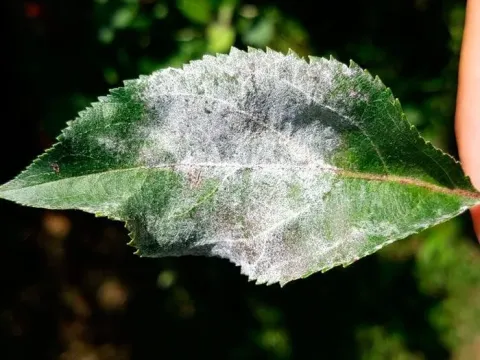
The hallmark symptom of an Ovulariopsis infection is the appearance of a white or grayish powdery layer, most commonly found on the underside of the leaves. In many host species, this is accompanied by distinct yellowing or chlorotic spotting.
Unlike some other powdery mildews, the infection often leads to premature leaf drop, which can be quite severe depending on the host species. Leaves may also show signs of distortion, curling, or necrosis as the fungal colony expands.
In advanced stages of the infection, the mycelial growth can extend to petioles, stems, and fruits. Affected tissues may eventually die, resulting in localized necrotic patches that disrupt the plant's normal physiological functions.
Visual observation of the fungal colonies reveals small, scattered patches of white mycelium that gradually enlarge and merge. The dust-like appearance is caused by the mass production of conidia on the surface of the infected tissue.
Diagnostic field identification is often aided by observing the underside of the leaves, where the mycelial mats are usually more concentrated compared to the upper surface, which is a characteristic feature of this pathogen.
Ovulariopsis thrives in moderate temperatures and high relative humidity. While it can withstand fluctuations in humidity better than some other powdery mildews, its germination and growth are optimal within the 18°C to 25°C range.
Poor ventilation and overcrowded planting density are primary drivers of outbreaks. A stagnant microclimate, common in dense tree canopies or poorly managed greenhouses, allows humidity to accumulate, facilitating spore germination.
Light intensity plays a significant role in plant susceptibility; plants growing in shaded or low-light conditions are generally more vulnerable. Adequate light exposure strengthens leaf tissues and can inhibit the efficiency of fungal penetration.
Frequent, light irrigation or dew formation provides the necessary surface moisture for conidia to germinate and form infection structures. Rapid changes in temperature can cause condensation on foliage, triggering immediate infection spikes.
The pathogen's spread is highly dependent on wind currents, which transport spores between plants. In protected cultivation, the lack of proper airflow control can turn a localized issue into a total crop infection within a few days.
The primary impact of Ovulariopsis is the impairment of photosynthesis, which occurs because the fungus blocks leaf pores and damages epidermal cells. This causes a significant reduction in the plant's vigor and overall growth rate.
Premature defoliation is a major problem for perennial crops, as it leaves the plants unprepared for winter, leading to reduced cold hardiness and potential winter injury or total dieback of vulnerable tissues.
In fruit-bearing crops, the infection degrades both the yield quantity and quality. Infected fruits may be smaller, show skin blemishes, or have reduced storage life, leading to significant economic losses for producers.
For ornamental plants, the presence of the pathogen severely reduces the aesthetic value, rendering plants unsalable in nurseries and garden centers. This often results in the immediate destruction of affected inventory.
Long-term infestation weakens the host plant, making it increasingly susceptible to secondary pests and opportunistic pathogens, thereby shortening the productive lifespan of trees and shrubs in the garden.
Effective control requires a multi-faceted approach centered on cultural practices. Proper pruning to ensure airflow and sunlight penetration within the canopy is crucial for keeping humidity levels low and inhibiting fungal growth.
Sanitation is a vital component of integrated pest management. Removing and destroying fallen leaves and infected shoots significantly reduces the overwintering inoculum source for the following season.
Chemical control measures typically involve the application of sulfur-based fungicides or systemic products such as triazoles and strobilurins. Preventive sprays are significantly more effective than curative treatments once the disease is well-established.
Biological control agents, including specific strains of fungi or bacteria that parasitize or compete with powdery mildews, are becoming increasingly popular in organic production systems to manage infections safely.
- Monitor crops regularly for early symptoms.
- Ensure proper plant spacing to minimize competition and improve aeration.
- Apply balanced fertilization to maintain overall plant health.
- Sterilize pruning tools between plants to prevent mechanical spread.