
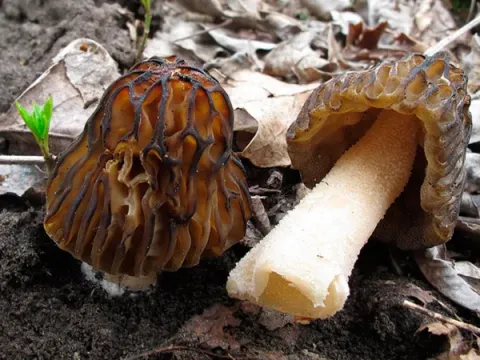
Mitrophora hybrida
Mitrophora hybrida
Mitrophora hybrida, commonly known as the half-free morel, belongs to the Ascomycota division and the Morchellaceae family. This fungus acts as a saprotroph, playing a vital role in recycling organic matter within forest ecosystems.
What the section contains
Mitrophora hybrida
Biologically, this species is a sac fungus where spores develop inside asci. In modern taxonomy, it is often classified within the Morchella genus (as Morchella hybrida), highlighting its close evolutionary relationship with true edible morels.
The fungus is not a pathogen for agricultural crops. On the contrary, it is considered a beneficial component of forest biota, participating in soil-forming processes. It is important to distinguish this species from parasitic fungal infections that damage harvests.
The fruiting body has a specific structure: the cap is conical and attached to the stem only at the upper part, hence the name "half-free." The surface is covered with honeycomb-like ridges and pits.
In an agronomic context, this object serves as a bioindicator of healthy forest soil. Its presence often indicates a rich humus layer and the appropriate microclimate required for balanced forest vegetation.
The main identifying feature is the cap, which is detached from the stem at the bottom. This is the primary morphological difference from standard morels, where the cap is attached to the stem along its entire length.
The cap color ranges from yellowish-tan to ochre-brown. The pits on the surface are relatively large and elongated, giving the fungus a characteristic appearance resembling a complex network or a honeycomb.
The stem of the fungus is hollow, cylindrical in shape, and often appears furrowed or granular. The stem color is usually lighter than the cap, transitioning from whitish to cream as the specimen matures.
The size of the fruiting body varies, typically ranging from 5 to 15 centimeters in height. They appear either as individual specimens or in small clusters connected by a common mycelium in the leaf litter.
When collecting, it is important to note that the odor of Mitrophora hybrida is mild and mushroom-like, without pungent notes. The texture of the flesh is quite fragile, making it difficult to transport after harvest.
Mitrophora hybrida prefers moist deciduous and mixed forests, especially those dominated by alder, aspen, and birch trees. The fungus favors areas with abundant organic material and moderate shade.
Mycelium development is most active during the spring season, when the soil is sufficiently warmed and saturated with snowmelt. The optimal temperature for the emergence of fruiting bodies is between 10 and 18 degrees Celsius.
Soil and air moisture levels play a critical role in the dispersal and growth of this fungus. In particularly dry springs, fruiting may be almost non-existent as the species is highly sensitive to the desiccation of the topsoil.
The fungus prefers fertile loamy soils with a neutral or slightly alkaline pH. It is often found along forest streams, floodplains, and damp lowlands where moisture is retained in the spring.
Human impact on its development conditions is moderate. Mitrophora hybrida can adapt to slightly modified landscapes, such as old parks or neglected woodland, provided the leaf litter remains undisturbed.
Mitrophora hybrida poses no threat to agricultural crops, fruit trees, or ornamental plants. In agronomic practice, it is not categorized as a pest or a disease.
Furthermore, this fungus does not produce toxins that inhibit the growth of neighboring vegetation. On the contrary, its mycelial activity contributes to the mineralization of forest debris.
The risk to humans is limited to the possibility of misidentifying the species as a poisonous one. However, in ecological terms, the species is perfectly safe for agro-ecosystems.
There are no recorded instances where Mitrophora hybrida has acted as a vector for infections affecting cultivated plants or influenced a reduction in land productivity.
Thus, the economic damage caused by this species in agriculture is zero. Conversely, the presence of such fungi in adjacent forest zones can be beneficial for maintaining overall biological diversity.
Protective measures regarding Mitrophora hybrida are unnecessary, as it is a beneficial component of the ecosystem and does not constitute a plant disease.
If fruiting bodies appear in a garden or orchard, it indicates high soil quality and a lack of chemical pollution, which is favorable for general garden health.
In cases where the presence of fungi is undesirable due to aesthetic or other reasons, it is sufficient to restrict irrigation in the specific area or loosen the soil, which will disrupt the conditions for fruiting body formation.
The application of fungicides to combat this species is completely unjustified and harmful to soil microflora. Using chemical agents against this mushroom will suppress beneficial saprotrophs.
The best strategy is to monitor the species' development. Mitrophora hybrida is an indicator of natural equilibrium, and its preservation contributes to the healthy growth of vegetation near fields.