
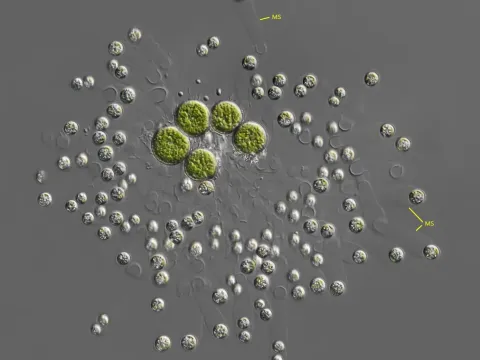
Mischococcus confervicola
Mischococcus confervicola
Mischococcus confervicola is a genus of yellow-green algae (Xanthophyta) that frequently acts as an epiphytic organism in aquatic environments.
What the section contains
Mischococcus confervicola
While not a typical parasitic pathogen in the traditional sense, it colonizes the surface of submerged aquatic plants and other filamentous algae.
The organism is characterized by colonies of spherical cells held together by a distinct mucilaginous envelope, which provides its unique slimy texture.
Biologically, it relies on the substrate provided by the host plant to anchor itself while absorbing nutrients directly from the surrounding water column.
Propagation is facilitated by the release of zoospores, which can easily move through the water to colonize new host surfaces.
The presence of Mischococcus confervicola is typically marked by the appearance of a slimy, granular film covering the submerged foliage of the plant.
The infected surfaces exhibit a dull or greenish appearance and become distinctly slippery to the touch due to the secretion of extracellular polysaccharides.
Growth of the host plant often shows a significant decrease as the algal colonies begin to physically block the leaf surface.
Under microscopic examination, the characteristic branched or chain-like structures of the colonies become visible, often appearing as slimy clusters.
In cases of heavy infestation, the affected areas of the plant may lose their natural brightness and eventually show signs of chlorosis or tissue decay.
The development of Mischococcus confervicola is highly dependent on eutrophic water conditions, characterized by high levels of phosphorus and nitrogen.
Optimal growth temperatures usually fall within the moderate range, promoting rapid colony expansion during the summer months.
Stagnant or slow-moving water is a key factor that allows spores to settle and develop into mature colonies on the surface of plants.
Excessive light intensity combined with high nutrient levels can trigger bloom-like conditions for these epiphytic algae.
Poor water filtration systems often fail to remove the dissolved organic matter that serves as a primary energy source for colonial algae.
The primary harm caused by this algae is the physical obstruction of gas exchange, which hinders the plant’s ability to perform essential respiratory and photosynthetic functions.
Competition for light is a significant factor, as the dense biofilm effectively shades the host plant's epidermis, reducing overall vigor.
The mucilage produced by the algae creates a niche for secondary bacterial infection and the accumulation of waste products on the plant's surface.
Commercial aquatic plant nurseries face direct economic losses, as colonized plants are rendered unsuitable for sale due to their unsightly appearance.
Over time, the affected plant parts may suffer from localized tissue death due to the persistent lack of oxygen and nutrient intake.
Effective management requires strict control of nutrient levels, particularly nitrates and phosphates, to reduce the fertility of the water column.
Improving water circulation and aeration is vital, as these measures prevent the accumulation of algal spores and disrupt the formation of slime layers.
Mechanical removal or pruning of heavily infested plant tissues is recommended to mitigate the spread of the colony within the tank or reservoir.
The application of selective algaecides can be considered, provided they are safe for the specific plant species and any associated aquatic fauna.
- Monitoring nutrient concentrations regularly.
- Increasing mechanical water filtration.
- Avoiding over-fertilization of aquatic systems.