
Micarea
Micarea
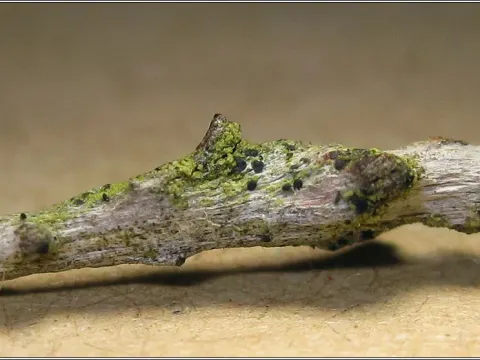
Micarea is a genus of crustose lichens that often colonizes the bark of trees and can be mistaken for pathogenic bark diseases.
What the section contains
Micarea
The growth appears as a thin, often granular or scaly patch on the surface of tree trunks and larger branches.
Coloration ranges from grey-green to yellowish or brownish, largely depending on the moisture content and sun exposure of the bark surface.
Unlike true bark pathogens, these lichens do not penetrate deeply into the cambium or cause structural decay within the wood.
Identification is straightforward: the lichen sits as a superficial layer that can be scraped off without disturbing the healthy bark structure underneath.
The organisms involved are lichens, which are composite organisms consisting of fungi and algae living in a symbiotic relationship.
They are not plant pathogens because they do not derive nutrients from the tree itself, making them benign inhabitants of the bark.
Ecologically, they are classified as epiphytes, meaning they use the tree exclusively as a physical substrate for survival.
The fungal component provides structure and protection, while the algae generate energy through photosynthesis, allowing the lichen to thrive.
Reproduction is primarily through spores, which are distributed by wind and moisture, eventually landing and germinating in bark crevices.
Micarea development is strictly governed by high atmospheric humidity, as lichens rely on moisture from the air to perform metabolic processes.
Shaded areas within orchards or forests are prime sites for colonization, as these locations retain moisture for longer periods after rainfall.
Older trees with rough, furrowed bark provide the ideal surface texture for spores to take hold and begin forming colonies.
Poor orchard management, specifically lack of canopy pruning, results in poor air circulation that facilitates lichen spread.
Stable, long-term exposure to moist conditions and lack of bark cleaning are the primary triggers for significant lichen development.
The harm caused by Micarea is largely indirect, as it creates an environment that may mask more serious underlying tree health issues.
A thick lichen cover can act as a refuge for various insect pests and mites, providing them with overwintering sites in the bark.
Dense growth can impede the visual monitoring of the tree, making it harder to detect early signs of bark cankers or fungal infections.
Excessive moisture retention under the lichen thallus can potentially soften the outer bark, making it more vulnerable to secondary microbial attacks.
While the lichen is harmless, its excessive presence on young, growing trees is often a symptom of poor overall plant vigor or site stress.
Routine mechanical cleaning of the trunks using stiff brushes is the most effective way to remove lichens and limit their spread.
This process should be performed carefully during the dormant season to ensure the underlying living bark is not damaged during the cleaning.
Applying a lime wash to the trunks acts as a preventative measure, creating an environment that is unfavorable for lichen colonization.
Pruning trees to improve light penetration and air circulation helps to dry out the bark, which significantly reduces the growth of epiphytes.
Maintaining optimal tree health through proper fertilization and watering minimizes the conditions that favor excessive lichen development.