
Currant and willow rust
Melampsora ribesii-viminalis
The causative agent of this disease is the heteroecious rust fungus Melampsora ribesii-viminalis. To complete its full life cycle, this pathogen requires two different plant hosts: currants (mainly black currant) and various species of willow trees.
What the section contains
Currant and willow rust
The fungus belongs to the Basidiomycota phylum and is characterized by a high degree of host specialization. Throughout the season, it passes through several spore stages, allowing it to successfully overwinter on fallen willow leaves and infect currant bushes in the spring.
On currants, the fungus develops primarily in the aeciospore stage, forming characteristic orange pustules on the underside of the leaves. This complex biological cycle makes disease control dependent on the proximity of willow plantations to berry patches.
The biology of the pathogen is closely tied to humidity dynamics and temperature conditions during the spring and summer. High spore activity occurs during prolonged rains, as free moisture facilitates the germination of conidia and the penetration of the mycelium into plant tissues.
The infection is often focal, but under favorable conditions, spores are easily dispersed by wind over significant distances, leading to the rapid spread of the disease across the entire garden or commercial plantation.
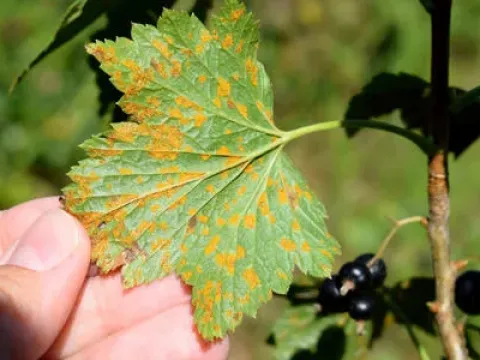
Initial symptoms on currant leaves appear in spring as bright orange, raised cushions located on the underside of the leaf blade. Later, yellowish spots may emerge on the upper side of the leaf, corresponding to the location of the aecia.
On willows, which serve as the primary reservoir for the infection in the second half of summer, signs appear as rusty-brown pustules. These formations cover a significant portion of the leaf surface, causing premature drying and defoliation.
Severe infection is accompanied by leaf deformation and slowed shoot growth. The plant appears stunted, loses turgor, and in cases of massive infection, leaves may drop as early as mid-August, preventing the bush from preparing for winter.
Visual diagnosis is relatively easy due to the specific "rusty" coating. A distinctive feature is the absence of necrotic margins, which are characteristic of other fungal leaf spots, helping to distinguish Melampsora from alternaria or septoria.
Microscopic examination of smears from infected areas reveals fungal spores, which serves as the final confirmation of the diagnosis. In the field, agronomists rely on the presence of the characteristic "cushions" on the underside of the leaf.
High humidity conditions, especially in May and June, promote the development of rust. Frequent fog, heavy dew, and prolonged rains create an ideal microclimate for spore germination on susceptible plant tissues.
A critical factor is the proximity of currant plantations to willow thickets. Since the fungus is heteroecious, the presence of both host species within a radius of a few hundred meters guarantees the annual renewal of the infection cycle.
A temperature range of +15 to +22 degrees Celsius is considered most favorable for active infection. In dry and hot weather, the intensity of disease development decreases significantly, as spores require water for successful germination.
Dense plantings and insufficient ventilation within the bush create conditions for moisture accumulation, which increases the risk of a rust outbreak. Lack of sanitary pruning and poor maintenance of tree rings also contribute to the persistence of the infectious background.
The infection persists in plant debris, making fallen leaves the primary source of spring re-infection. The more infected foliage left under the bushes in autumn, the stronger the disease manifestation will be in the next season.
The primary damage lies in a sharp reduction of the leaf's photosynthetic surface area. Due to massive infection, photosynthetic processes slow down, leading directly to reduced berry size and poorer taste quality.
Premature leaf drop deprives the plant of the opportunity to accumulate sufficient nutrient reserves in shoot tissues and roots. This leads to a significant reduction in the winter hardiness of the currant and can cause partial freezing of the bush during winter.
Plants weakened by the disease become more susceptible to other pathogens and pests. Gradual exhaustion of the shrub leads to lower yields not only in the current year but also in subsequent seasons, making the variety economically unviable.
In nurseries, rust infection is unacceptable as it degrades the quality of planting material and can lead to bans on the sale of seedlings. The infection can completely destroy the marketability of young plants in a short period.
Overall garden productivity in the absence of control measures falls by an average of 30–50% over a few years. In severe cases, chronic infection leads to the death of the bushes, especially if they are already weakened by other adverse environmental factors.
The most important preventive measure is the spatial isolation of currant plantations from willow thickets. If willows grow near the site, periodic removal or sanitary fungicide treatments in conjunction with the berry bushes are necessary.
A mandatory agrotechnical practice is the thorough collection and disposal of fallen leaves in autumn. Burning or deep incorporation of plant debris into the soil deprives the fungus of overwintering sites and significantly reduces the level of primary infection in the spring.
For chemical protection, fungicides from the triazole group or copper-based preparations are used. Treatments are conducted as a preventive measure before and immediately after flowering to prevent massive spore germination on young leaves.
The use of resistant currant varieties is the most effective long-term solution. Breeding efforts are focused on developing forms that possess high tolerance to Melampsora ribesii-viminalis and prevent the pathogen from developing in large quantities.
Maintaining optimal agrotechnics is essential: timely pruning, balanced fertilization, and proper watering contribute to enhancing plant immunity. A healthy, vigorous bush is much better at resisting fungal attacks than a stunted plant.