
Curvularia blight
Curvularia inaequalis
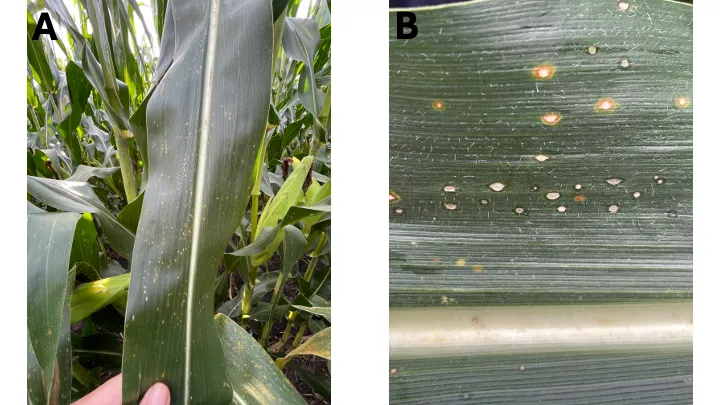
Description
Symptoms
Symptoms typically begin as small, chlorotic spots on leaves that soon enlarge and develop into reddish-brown or dark brown lesions with irregular margins.
In many cases, a distinct dark-colored mold appears on the surface of the lesions, which consists of the sporulating structures of the fungal pathogen.
When the infection spreads to the floral parts, it can result in head blight or grain spotting, leading to shriveled kernels and overall grain quality degradation.
Severe infestations often cause necrosis of the leaf blades, which can lead to premature senescence and a drastic reduction in the plant's photosynthetic capacity.
In seedlings, the infection may cause damping-off or brown rot of the coleoptile, resulting in weak plants and decreased stand density.
Pathogen
The causative agent of this disease is the fungus Curvularia inaequalis, an anamorphic pathogen classified within the division Ascomycota (teleomorph: Cochliobolus inaequalis).
The fungus is known for its ability to produce large amounts of conidia, which serve as the primary inoculum for spreading the infection to healthy plants.
It acts as a facultative pathogen, capable of saprophytic survival on crop residues and necrotic tissue, which allows it to overwinter successfully in the soil.
The mycelium of the pathogen is typically brown or dark olive in color, composed of septate hyphae that invade plant tissue by secreting specialized enzymes.
Its biological cycle is highly dependent on environmental humidity, as the spores require a film of moisture for germination and subsequent penetration into the host.
Conditions for development
Curvularia blight thrives under warm and humid conditions, with optimal development occurring at temperatures between 20°C and 30°C.
High humidity and prolonged leaf wetness, often caused by heavy dew or frequent rainfall, are critical environmental triggers for the outbreak of the disease.
Poor field hygiene, such as leaving infected plant debris on the soil surface, facilitates the build-up of the inoculum and promotes future infections.
Excessive nitrogen fertilization can create succulent plant tissue that is more vulnerable to penetration by fungal hyphae.
Dense planting patterns that restrict airflow create a microclimate with stagnant, humid air, which significantly enhances the spread of the fungal spores.
Why it matters
The primary economic impact is the direct reduction of grain yield, caused by poor kernel filling and increased rates of pre-harvest sprouting.
Contaminated seeds often exhibit poor germination rates and low vigor, which creates a negative cycle of infection for subsequent planting seasons.
The disease causes a loss of green leaf area, which limits the energy available for the plant to complete its reproductive cycle effectively.
Secondary infections by other opportunistic microorganisms are more common in plants already stressed by Curvularia blight, further weakening the crop.
Producers face financial losses not only from yield reduction but also from the increased cost of fungicide applications required for effective disease suppression.
Protection
The use of certified, disease-free seed treated with systemic fungicides is the first line of defense against Curvularia species.
Implementing a diverse crop rotation is essential to break the survival cycle of the pathogen and reduce its population in the soil.
Deep plowing or effective tillage practices that incorporate crop residues deep into the soil help to accelerate the decomposition process.
Balanced plant nutrition, focusing on potassium and phosphorus, helps to toughen plant cell walls and improve innate disease resistance.
- Monitor fields during the flowering and grain-filling stages to detect early disease signs.
- Apply foliar fungicides during critical growth stages if environmental conditions favor disease.
- Ensure proper field drainage to prevent localized humidity build-up and leaf wetness.
Discussion
No discussions yet — be the first.