
Curvularia blight
Curvularia ravenelii
Description
Symptoms
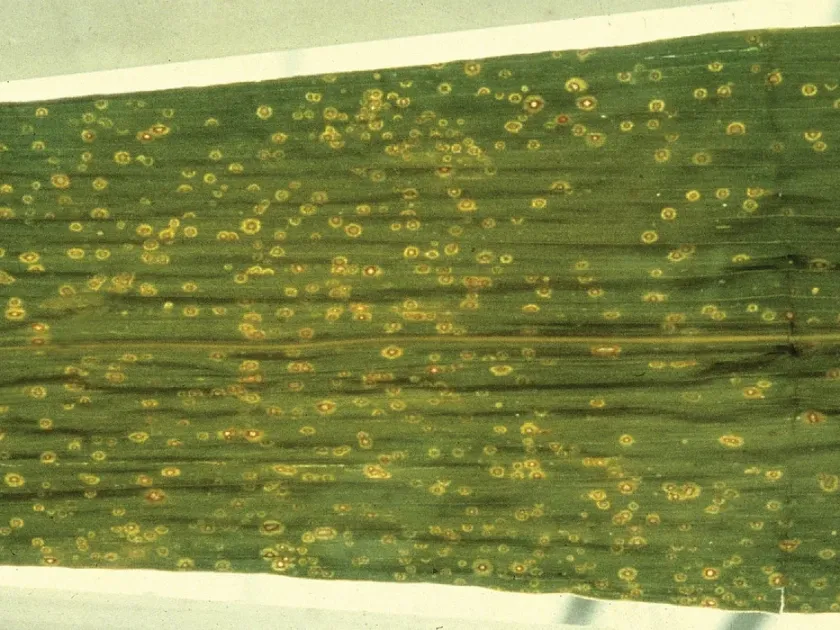
The characteristic symptoms of the disease include the appearance of necrotic lesions on leaves, sheaths, and sometimes the spikelets of the host plants.
These spots initially appear as small dark brown specks, which expand over time to form larger, irregularly shaped dark lesions often surrounded by a chlorotic halo.
Under conditions of high humidity, the lesions become covered with a velvety, dark olive or black fungal mass, which is evidence of heavy sporulation.
Affected plants often display premature leaf senescence, yellowing, and eventually dying from the bottom up as the infection progresses upward.
Spike damage may lead to shriveled grains or poor head development, significantly impacting the overall physiological health of the crop.
Pathogen
The causative agent of the disease is the fungus Curvularia ravenelii, which belongs to the group of hyphomycetes. This pathogen is known for its ability to persist in plant debris and soil for extended periods.
The fungus produces dark-pigmented multi-celled conidia that are easily dispersed by wind and splashing rain, allowing the infection to spread rapidly across fields during favorable weather.
Curvularia ravenelii acts as a parasite that colonizes various plant tissues, utilizing extracellular enzymes to break down host cell structures and obtain nutrients.
The pathogen primarily targets cereal crops, establishing infection through stomata or mechanical injuries on the leaf surface and other aerial plant parts.
Its complex lifecycle allows it to adapt to different environmental conditions, making it a persistent threat in regions with humid growing seasons.
Conditions for development
Curvularia blight development is strongly correlated with periods of high relative humidity and abundant rainfall, which facilitate spore germination and fungal growth.
The optimal temperature range for the pathogen's activity is generally between +22°C and +28°C, which frequently coincides with the active growth phase of cereal crops.
Poor aeration within dense crop canopies creates a microclimate with high moisture levels, which is highly conducive to the proliferation of Curvularia ravenelii.
Stress factors such as nutritional imbalances or damage caused by pests can render plants more susceptible to the fungal attack, leading to more severe disease outbreaks.
Longer dew periods during the nights provide sufficient moisture for the conidia to germinate and penetrate the plant epidermis effectively.
Why it matters
The economic impact of this disease is primarily manifested through significant yield losses, as the damage to foliage restricts photosynthesis and grain filling.
Infection leads to smaller, shriveled grains that result in reduced test weight and overall grain quality, often making the harvest unsuitable for milling or seed purposes.
The disease weakens the plants, making them more susceptible to lodging and colonization by secondary pathogenic organisms that further diminish crop health.
In severe cases, the infection can cause widespread crop failure, resulting in substantial financial losses for farmers and increased costs for disease management.
Seed-borne infection is a critical concern, as it serves as a primary inoculum source that reduces germination rates and compromises the vigor of future crops.
Protection
Integrated disease management for Curvularia blight relies heavily on crop rotation to reduce the load of inoculum present in the field soil.
Sanitation practices, including the deep incorporation of crop residues, are essential to destroy the overwintering structures of the fungus.
The application of registered fungicides during the critical growth stages, especially during wet weather, is effective in preventing the spread of the pathogen.
Seed treatment using systemic fungicides before planting helps protect young seedlings from early-season infection, ensuring a uniform and healthy stand.
- Utilizing disease-resistant or tolerant crop varieties.
- Managing weed hosts to minimize the reservoir of the fungus.
- Optimizing fertilizer application to maintain vigorous plant health.
Discussion
No discussions yet — be the first.