
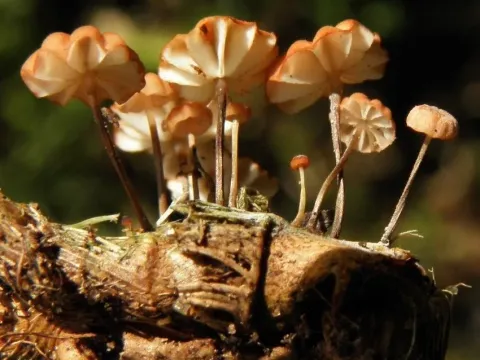
Marasmius graminum
Marasmius graminum
The causative agent of this disease is the fungus Marasmius graminum, a member of the Marasmiaceae family. While typically a saprotroph, it can act as a pathogen, thriving on plant debris and potentially attacking weakened living tissues.
What the section contains
Marasmius graminum
The fungus develops an extensive network of mycelium that can rapidly colonize agricultural fields. It secretes specific enzymes capable of breaking down cellulose in cereal tissues, which facilitates its spread.
The life cycle of the pathogen is closely tied to humidity levels. It overwinters as mycelium in the soil or on crop stubble, producing fruiting bodies when spring conditions become favorable for spore dispersal.
Spores are efficiently spread by wind currents and rain splashes. Once the spores land on host plants, they germinate, starting the infection process whenever the environmental conditions remain sufficiently moist.
Due to its high adaptability, the pathogen can persist in the soil for extended periods. Its ability to switch between saprotrophic and parasitic modes makes it a significant risk factor in humid climates.
The initial signs of infection include small yellow or pale spots on the leaves and stems. These spots gradually expand and darken, eventually developing into necrotic lesions.
High moisture levels often lead to the appearance of a thin, white or grayish fungal mat on the surface of infected tissues. In advanced stages, small, delicate fruiting bodies of the fungus may appear on the lower stems.
Infected plants typically show signs of stunted growth and general vigor loss. Lower leaves usually start to yellow and die back prematurely, affecting the overall physiological state of the crop.
The disease often appears in patches throughout the field, reflecting areas with microclimatic conditions that favor fungal growth, such as poor drainage or inadequate air circulation.
Distinguishing Marasmius graminum from other foliar diseases can be challenging. A precise diagnosis often requires microscopic observation of the mycelium or the characteristic fruiting bodies.
High humidity and consistent moisture are the most critical factors for the development of Marasmius graminum. Excessive rainfall, heavy fog, and dew provide the necessary environment for the fungus to thrive.
Temperature plays a crucial role in spore germination and mycelial spread. The pathogen is most active in temperatures ranging from 18 to 25 degrees Celsius, which are typical for spring and early summer growing seasons.
Dense crop stands create a restricted microclimate where air movement is minimal. This lack of ventilation traps humidity, creating a perfect environment for the fungus to establish and spread.
Accumulation of crop residues on the soil surface acts as a reservoir for the pathogen. Fields with poor field hygiene are significantly more susceptible to outbreaks of this fungal disease.
Poor soil aeration and waterlogging are other contributing factors that weaken the plants and promote the development of the disease. Healthy, well-ventilated crops are generally more resistant.
The disease causes economic harm by reducing the leaf surface area available for photosynthesis. This decline in photosynthetic capacity leads to smaller grains and lower total crop yield.
By attacking the base of the stems, the fungus compromises the mechanical integrity of the plants. This increases the risk of lodging, which makes mechanical harvesting difficult and increases harvest losses.
Severe infections can reduce grain weight and quality significantly. Grains from heavily infected crops may be shriveled, reducing their market value and utility for processing.
The presence of the fungus often weakens the plant's natural defense systems, making it more susceptible to secondary infections by other pathogens, which can complicate the overall health of the field.
Direct economic losses are compounded by the costs of applying fungicides and potential yield losses. Effective management is essential to minimize the long-term impact on farm profitability.
Effective management begins with good cultural practices. Proper tillage and the deep incorporation of crop residues help to reduce the primary inoculum load in the soil.
Implementing a robust crop rotation scheme is vital. By rotating cereals with non-host crops, farmers can effectively disrupt the life cycle of the pathogen and reduce disease pressure.
Balanced fertilization, particularly with adequate potassium, boosts the plant's natural resistance. Avoiding excessive nitrogen applications is important to prevent overly lush, succulent tissue that is easier for the fungus to penetrate.
Fungicides can be used as a targeted intervention when environmental conditions favor disease development. Early detection through regular field scouting is crucial for timely and effective application.
Optimizing plant density and improving field drainage are key to maintaining a microclimate that is unfavorable for fungal growth, thereby naturally suppressing the disease.