
Maize streak
Maize streak
The disease is caused by the Maize streak virus (MSV), a member of the Geminiviridae family, characterized by a single-stranded circular DNA genome.
What the section contains
Maize streak
It is a highly significant pathogen that affects various cereal crops, primarily maize, sorghum, and winter wheat, acting as a widespread agricultural threat.
The transmission is strictly carried out by leafhoppers of the genus Cicadulina, with Cicadulina mbila being the most prominent vector species.
The virus circulates within the vector, and once a leafhopper acquires the virus through feeding, it remains infectious for the remainder of its life cycle.
There is no evidence of seed transmission or mechanical transmission; therefore, the presence of the insect vector is essential for the disease to spread.
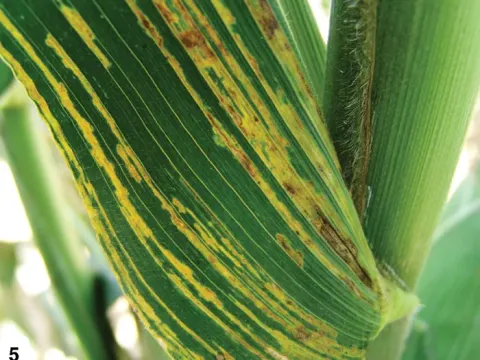
Early symptoms appear as small, faint chlorotic spots on the leaves, which eventually develop into elongated streaks running parallel to the leaf veins.
These streaks can be continuous or broken, creating a distinct mosaic pattern that results from the loss of chlorophyll in the infected leaf tissue.
As the infection progresses, the leaves may become entirely yellow, leading to premature tissue necrosis and significantly hampered plant physiology.
Infected plants display severe stunting, reduced internode length, and a generally weakened appearance compared to healthy neighboring plants.
Reproductive growth is often severely impacted, resulting in small, poorly filled cobs or the complete failure of the plant to produce ears.
Environmental factors that favor the breeding and migration of Cicadulina leafhoppers are the primary drivers of Maize streak virus outbreaks.
Warm temperatures and moderate humidity levels accelerate the insect's life cycle, leading to rapid increases in vector populations in agricultural fields.
Weed-infested fields act as reservoirs for the virus, as many wild grasses serve as alternative hosts for both the pathogen and the leafhopper vectors.
Late-planted maize crops are often at higher risk, as they coincide with the peak migration periods of leafhopper populations from older or wild vegetation.
The proximity of maize fields to winter wheat or perennial pastures creates a bridge that facilitates the early-season movement of the virus into new crops.
The economic impact of the disease is profound, as infected plants experience significantly reduced photosynthetic efficiency and diminished biomass accumulation.
In severe cases, especially when infection occurs at the seedling stage, the crop loss can be absolute, leading to complete field failure.
Plants affected by MSV exhibit reduced root development, making them more susceptible to drought stress and wind lodging as the season progresses.
The overall quality of the grain is degraded, and the yield components, such as ear size and grain weight, are heavily compromised.
- Significant reduction in grain yield
- Diminished forage quality for silage
- Increased predisposition to secondary pathogens
Planting resistant or tolerant maize varieties is the most effective and sustainable strategy for managing the risk of Maize streak virus infections.
Integrated pest management, including the use of targeted insecticides to control leafhopper populations, is necessary in high-risk areas during early growth stages.
Effective weed management within and around the fields is crucial to minimize alternative hosts for the virus and breeding sites for the insect vectors.
Adjusting planting dates to avoid alignment with peak leafhopper migration patterns can significantly reduce the incidence of infection in maize crops.
Maintaining spatial isolation from potential virus sources, such as older susceptible cereal crops or wild grasses, helps protect vulnerable young seedlings.