
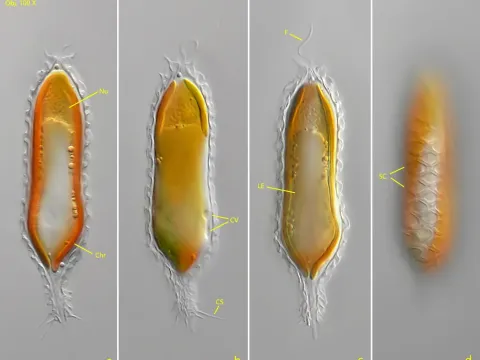
Mallomonas insignis
Mallomonas insignis
Mallomonas insignis is a species of golden-brown algae (Chrysophyceae). It is a unicellular organism characterized by silica scales that cover its surface in a distinctive pattern.
What the section contains
Mallomonas insignis
While not a plant pathogen in the sense of attacking crops directly, it functions as a biological agent that affects aquatic ecosystems. Its biological classification places it within the planktonic community.
The organism uses photosynthesis to produce energy. Its cellular structure includes flagella, allowing it to navigate the water column to find the best light conditions for growth.
In agronomy, this species is categorized as a water quality indicator. Its proliferation is a sign of ecological shifts within the water source used for irrigation.
The biology of this species is sensitive to environmental variables, which allows it to multiply rapidly when conditions are favorable for golden algae blooms.
The development of Mallomonas insignis is closely tied to water temperature. It typically thrives in cool to moderate conditions, often peaking during spring or autumn.
High nutrient levels, especially phosphorus and nitrogen, are the primary triggers for significant population surges. Runoff from agricultural fields is a common cause.
Light availability is essential for the photosynthetic processes of this organism. Stable water surfaces with limited movement promote faster population growth.
Stagnant water bodies are more prone to infestations compared to flowing rivers. Low circulation allows for the concentration of biomass in the upper layers of the water.
The chemical profile, specifically pH levels, influences the suitability of a pond for this species. It prefers specific acidity levels common in many freshwater systems.
The main issue caused by this algae is the bloom phenomenon, which degrades water quality. This is particularly problematic for sensitive irrigation equipment.
The decay of accumulated biomass consumes dissolved oxygen in the water. This rapid depletion can lead to hypoxic conditions that harm local aquatic biodiversity.
Algal metabolism releases organic substances into the water, potentially affecting its odor and chemical composition. This can be detrimental if used for plant fertigation.
The physical presence of silica-scaled cells leads to clogging in drip irrigation emitters and filtration systems. This results in higher maintenance costs for farmers.
General degradation of water quality caused by massive algal growth interferes with the efficiency of chemical inputs added to the irrigation water.
Managing nutrient influx is the most effective long-term strategy. Reducing fertilizer runoff into ponds significantly limits the food supply for the algae.
Mechanical aeration is highly recommended for irrigation reservoirs. Keeping the water in constant motion disrupts the conditions required for algal bloom formation.
Installation of high-quality filtration systems and UV sterilizers is necessary to treat water before it enters the irrigation network, protecting the equipment.
Biological control methods include encouraging the growth of native macrophytes. These plants act as competitors, absorbing nutrients that would otherwise fuel algal growth.
Regular water testing allows for early detection of population increases. Preventive measures should be implemented as soon as nutrient levels show a rising trend.