
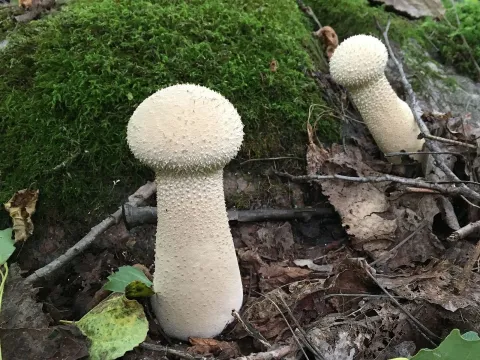
Pestle puffball
Lycoperdon excipuliforme
The pestle puffball (Lycoperdon excipuliforme) is characterized by a distinct club-shaped or pestle-like fruit body supported by a thick sterile stalk.
What the section contains
Pestle puffball
In its early stages, the fruit body is white with a surface covered in tiny, soft spines or scales that typically fall off as the mushroom matures.
As the fungus reaches maturity, the color changes to brownish, and the interior develops into a powdery mass of spores released through a small apical pore.
Unlike parasitic plant diseases, this fungus does not produce leaf spots, wilting, or tissue decay on host crops as it relies on dead organic matter.
The presence of the fungus is often overlooked until the fruiting bodies emerge from the soil or decaying wood during the late summer or autumn.
This organism is a saprophytic fungus belonging to the Agaricaceae family, meaning it obtains nutrients from decomposing organic material.
It acts as a decomposer in the ecosystem, breaking down cellulose and lignin, and is not a pathogen for living agricultural or garden crops.
The vegetative part of the fungus, the mycelium, spreads through the soil substrate, creating a network that facilitates nutrient recycling.
Spore dispersal occurs primarily through wind and rain splashes, allowing the fungus to colonize areas with abundant woody debris or leaf litter.
Its biological cycle is strictly tied to environmental conditions, specifically moisture availability and the presence of suitable organic substrates.
The pestle puffball thrives in environments with high soil humidity and moderate temperatures, typically occurring after heavy rains in summer and autumn.
Shaded garden areas with significant accumulations of mulch, wood chips, or decaying logs provide an ideal habitat for its development.
Poorly drained soils or areas prone to compaction often host these fungi because the environment remains consistently moist for longer periods.
Acidic soil pH is often favored by this species, as it provides a competitive advantage over other soil-dwelling microorganisms.
Minimal soil disturbance, such as in no-till gardens or orchards, promotes the establishment of stable mycelial colonies.
The pestle puffball is not considered a crop pathogen, and it does not damage living plant tissues or impede agricultural productivity.
It occupies an ecological niche that is beneficial for natural waste degradation, and it does not pose a chemical or biological threat to garden plants.
In rare instances, its presence might be considered an aesthetic nuisance on lawns or in decorative garden beds if the fruit bodies appear in groups.
There is no evidence of the fungus secreting secondary metabolites that would interfere with plant growth or soil fertility.
Mistaking this beneficial saprophyte for a harmful plant disease can lead to unnecessary and potentially harmful applications of fungicides.
No chemical control is required, as the pestle puffball does not function as a plant disease and does not threaten crop harvests.
To reduce its presence, gardeners should focus on cultural practices such as removing large pieces of decaying wood or excess woody mulch.
Improving soil drainage and aeration will create a less favorable environment for its mycelium to persist in the ground.
Maintaining a clean garden bed by removing old, decomposing organic matter effectively prevents the fungus from finding a food source.
Simply removing the fruiting bodies before they release their spores is sufficient to limit their local spread in any specific area of the garden.