
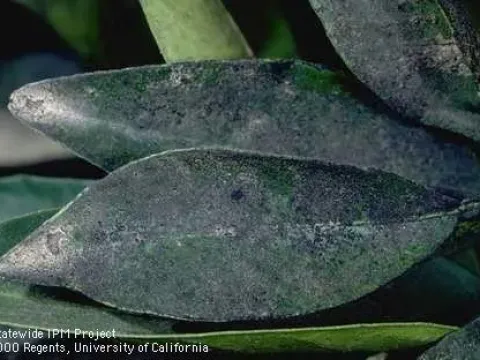
Sooty mold of citrus
Limacinia penzigii
The disease is caused by the fungus Limacinia penzigii, which belongs to the sooty mold group of fungi.
What the section contains
Sooty mold of citrus
This fungus is an epiphyte that grows on the surface of plant parts rather than invading the internal tissues of the tree.
Its survival and proliferation are directly linked to the presence of honeydew secreted by sap-sucking insects like scales and aphids.
The mycelium forms a dark, dense crust that spreads across leaves, twigs, and fruits, creating the characteristic appearance of soot.
Spores are disseminated by wind, rain, and physical contact with insects, ensuring rapid infection across an orchard or indoor plant collection.
The primary symptom is the presence of a black, velvet-like coating covering the surface of leaves, branches, and citrus fruits.
Initial signs appear as small black patches, which eventually merge to cover large areas of the plant's foliage.
The moldy layer can be wiped off when the infection is fresh, but it becomes more persistent and tough as the fungal colony matures.
Flowering and young fruit development are often hindered, leading to stunted growth or premature abscission of the affected plant organs.
The foliage loses its natural deep green color, looking dull and dirty under the thick, black fungal growth.
High relative humidity and warm temperatures create the perfect environment for the growth of Limacinia penzigii spores.
The presence of honeydew-producing insects is the most critical factor, providing the necessary nutrients for the fungus to thrive.
Poor airflow within the tree canopy, often caused by lack of pruning, keeps the environment moist and encourages fungal establishment.
Overcrowded plantations or dense greenhouse conditions significantly increase the rate of secondary infections among trees.
Lack of proper hygiene and pest management allows the fungus to sustain itself throughout the growing season.
The most significant damage is the blocking of sunlight, which inhibits the plant's ability to carry out photosynthesis effectively.
This reduction in photosynthetic activity leads to weakened plants, yellowing leaves, and reduced overall vigor of the citrus tree.
Plant respiration is disrupted as the black layer covers the stomata, preventing necessary gas exchange between the plant and the air.
The aesthetic value of fruits is severely compromised, rendering them unsuitable for sale as high-quality market produce.
Persistent infection leads to decreased yields and makes the tree more susceptible to secondary stressors and diseases.
The most effective strategy is the rigorous control of sap-sucking pests like scales, aphids, and whiteflies using suitable insecticides.
Pruning is essential to open up the canopy, improve ventilation, and reduce the moisture trapped within the foliage.
Washing the affected leaves with mild soapy water or high-pressure water streams can physically remove the soot buildup.
Fungicide applications may be necessary in severe outbreaks to suppress fungal growth and prevent further spread.
- Management of honeydew-producing insect populations.
- Canopy pruning to increase airflow.
- Physical cleaning of leaves and branches.
- Preventive application of appropriate fungicides.