
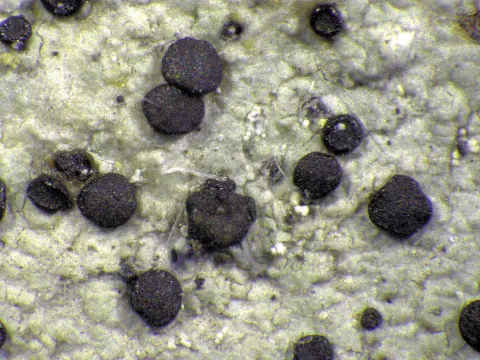
Lecidea
Lecidea
Lecidea is a large genus of crustose lichens belonging to the family Lecideaceae. It is essential to clarify that this is not a plant pathogen or a disease-causing agent, but a symbiotic organism consisting of a fungus and an alga.
What the section contains
Lecidea
In biological terms, Lecidea is classified as an epiphyte. It attaches to the bark of trees, rocks, or soil to live, but it does not derive nutrients or moisture directly from the living plant tissue.
The lichen does not cause plant diseases, although its presence is often misidentified by gardeners as a sign of a pathological condition.
The biology of Lecidea involves a crust-like thallus that adheres very tightly to the surface, making it appear as a natural part of the tree bark structure.
Lichens within this genus reproduce through spores dispersed by the wind, allowing them to colonize new environments where the moisture and substrate conditions are suitable.
The most common sign of Lecidea is the appearance of grainy or smooth patches on the bark, which can be grey, whitish, or brownish in color.
Unlike parasitic fungi, these patches do not cause lesions, rot, or necrosis. The tissue underneath the lichen typically remains healthy and intact.
Small, dark, disc-like structures called apothecia are often visible on the surface of the lichen; these are the reproductive organs where spores are produced.
The bark where Lecidea is present may look rougher or aged, which is why it is often associated with older, slower-growing trees rather than young, vigorous saplings.
Observing the distinct shape and color of the lichen patches helps differentiate them from powdery mildew, rusts, or other infectious plant diseases.
Lecidea requires stable environmental conditions, particularly high humidity, to thrive. It is most common in shaded, poorly ventilated areas of an orchard.
Because these lichens are sensitive to air pollution, their presence often indicates good air quality in the surrounding environment.
Old trees with slow-growing, static bark provide the best surface for Lecidea to establish its colonies, as the crust is not easily shed.
Reduced sunlight and dense canopies create a favorable microclimate, preventing the bark from drying out and allowing the lichen to expand its range.
Periods of prolonged wet weather facilitate the dispersal and germination of spores, leading to more visible lichen cover on tree trunks and branches.
While Lecidea is not a parasite, heavy colonization of bark can be undesirable for commercial fruit production or aesthetic garden maintenance.
A thick layer of lichen may slightly impede the gas exchange of the bark, which can have a minor negative impact on the overall health of the tree over many years.
The moisture trapped beneath the lichen provides a perfect hideout for various pests, such as scale insects or spider mites, which can cause real damage to the plant.
Extensive lichen cover often serves as a secondary indicator that a tree is lacking vigor or proper maintenance, prompting the need for cultural improvements.
Finally, the visual impact of heavy lichen growth on trees is often viewed as a sign of neglect, which may influence the marketability of orchard products.
The most effective long-term control is good horticultural practice: regular pruning to ensure proper sunlight penetration and airflow throughout the canopy.
Mechanical removal of the lichens can be achieved by gently scrubbing the bark with a stiff brush during the dormant season, which does not harm the healthy bark.
Applying a protective whitewash to the trunk and main branches is a traditional and effective method to discourage the re-establishment of lichen colonies.
Copper-based fungicides used as dormant sprays are highly effective in killing lichens and preventing the spread of their spores to other parts of the tree.
Promoting vigorous tree growth through proper fertilization and watering helps the tree shed its outer bark layers naturally, naturally reducing the surface available for lichen colonization.