
Legal's bolete
Boletus legaliae
Description
Symptoms
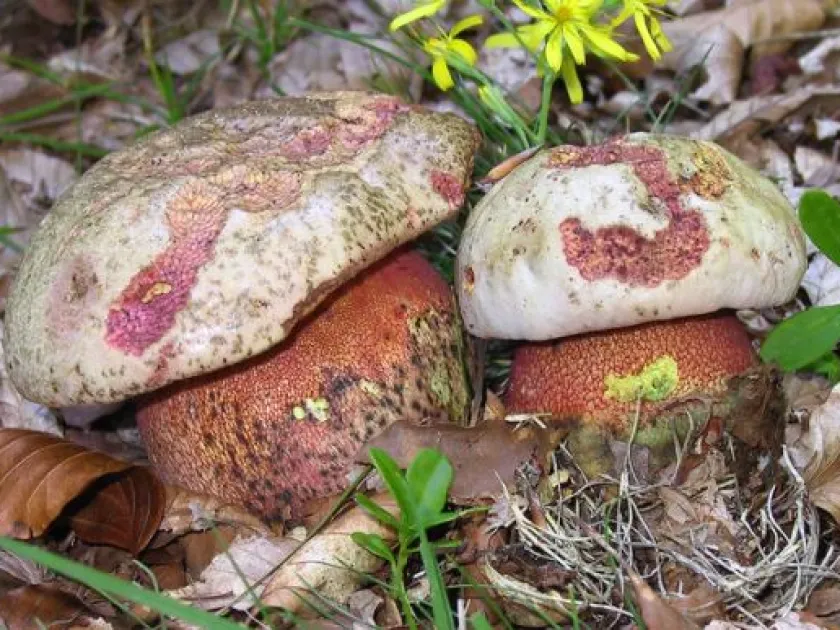
The fruiting body has a massive cap with a diameter of 5 to 15 centimeters, which is convex in young mushrooms and becomes flat over time.
The surface of the cap is colored in pale, grayish-pink or cream tones, often with a noticeable pinkish hue, which is an important diagnostic sign.
The flesh of the mushroom quickly changes color to bright blue when cut. This is an oxidation reaction of pigments, typical for many boletes, including poisonous species.
The stem is club-shaped and covered with a distinct pink or reddish mesh. The tube layer under the cap varies from yellow to an olive shade.
The smell of the mushroom is often described as unpleasant, resembling rot or rubber, which is a warning signal for any mushroom picker.
Pathogen
Legal's bolete (lat. Boletus legaliae) is not a phytopathogen or a plant disease. It is a mycorrhizal fungus from the Boletaceae family, classified as a poisonous species.
It is incorrect to consider this organism a pathogen or a "disease," as it does not parasitize crops. In biological classification, it is an independent species of eukaryotes.
The mycelium of this fungus forms a symbiosis with the root systems of deciduous trees, creating ectomycorrhiza. This process is natural for forest ecosystems and does not harm agricultural crops.
The fungus was described as a separate species, closely related to the Satan's bolete. Its biological role is limited to processing organic matter and exchanging nutrients with host trees.
It is important to distinguish between phytopathogenic fungi that affect crops and forest mushrooms, which are part of the natural biocenosis and pose no threat to agricultural practices.
Conditions for development
This species prefers to grow in broad-leaved forests, especially in areas dominated by oak and beech, which are the main mycorrhizal partners.
The development of fruiting bodies occurs mainly in the summer-autumn period, when the soil is warm enough and saturated with moisture after rains.
The fungus is sensitive to the chemical composition of the soil, preferring calcareous substrates where its activity is most stable.
Moderate climate conditions without extreme frosts are necessary for mycelium formation, which limits its range to specific geographical zones.
Spore dispersal occurs through wind transport and the activity of forest animals, which contribute to the expansion of colonies within suitable habitats.
Why it matters
The main danger of this object lies in its high toxicity when consumed by humans. The mushroom contains heat-stable toxins that cause severe gastrointestinal distress.
Symptoms of poisoning include nausea, repeated vomiting, diarrhea, and sharp abdominal pain, appearing shortly after ingestion.
Despite its toxicity to mammals, in the forest ecosystem, the fungus is not a pathogen and does not inhibit the growth of nearby cultivated plants.
In the context of agronomy, the mushroom poses no threat to crops, but mushroom pickers may mistake it for edible bolete species, creating a social hazard.
If found on plots adjacent to forests, no special eradication measures are required, as it does not damage garden crops.
Protection
Protective measures are not needed as the object is not an agricultural pest or a plant disease pathogen.
The main method of "protection" is informing the public and teaching them how to recognize edible mushrooms to exclude the accidental consumption of toxic species.
If accidentally found in a garden, it can simply be removed mechanically using regular garden gloves if it interferes with the plot's aesthetics.
It is important to carry out regular inspections of the border areas between the garden and the forest, especially if there are children, to prevent dangerous contacts with mushrooms.
Poisoning prevention relies on strict adherence to the rule: do not collect mushrooms if you are not 100% sure of their species identification.
Discussion
No discussions yet — be the first.