
Lecanoromycetidae
Lecanoromycetidae
Lecanoromycetidae constitute the largest subclass of Ascomycota, primarily known as lichens. These organisms appear as crusty, leaf-like, or branched growths on tree trunks and branches.
What the section contains
Lecanoromycetidae
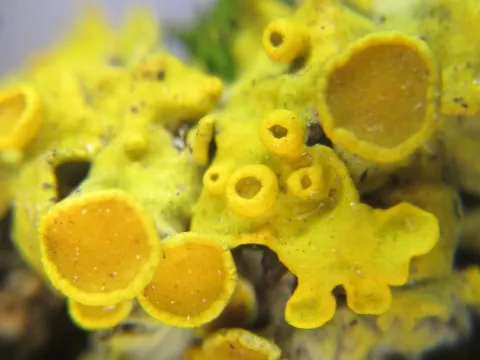
Visually, they present as patches of various colors including grey, white, yellow, or orange. These growths are firm and often become leathery when dry, yet they are not part of the tree tissues.
Unlike parasitic fungi, they do not cause tissue death, lesions, or wilting. Their presence is superficial and they do not derive nutrition from the host plant's internal sap.
Small disc-shaped structures known as apothecia are often visible on the surface of these lichens. These are the reproductive organs where fungal spores develop to propagate the organism.
Distinguishing them from actual pathogens is simple: lichens are purely epiphytic and can be wiped away from the bark without revealing signs of decay or damage underneath.
Lecanoromycetidae are not plant pathogens. They are mutualistic associations between a fungus (the mycobiont) and algae or cyanobacteria (the photobiont), forming a lichen.
The fungus provides structural support and protection from environmental stress, while the algae supply the organic nutrients through photosynthesis, making the lichen self-sufficient.
They do not invade the cambium, xylem, or phloem of the tree. The tree serves only as a structural substrate for these organisms, much like a rock or a wall.
There are no biochemical interactions that indicate parasitism. The lichenized fungus remains on the surface, indifferent to the physiological processes of the tree itself.
Therefore, their presence should not be treated as a disease. They are natural components of woodland and orchard biodiversity, acting more as air quality indicators than pests.
Lecanoromycetidae thrive in environments with specific moisture and light levels. They are commonly found in regions with high atmospheric humidity and good exposure to light.
Orchards with poor ventilation and dense canopies are ideal for their colonization. Proper pruning ensures adequate air circulation, which naturally discourages their growth.
Lichens are highly sensitive to air quality. Their absence in urban or industrial areas is usually a clear sign of high sulfur dioxide levels and atmospheric pollution.
Older trees with slow-growing bark are preferred substrates for lichens because the surface remains stable for a long time, allowing them to establish large colonies.
In dry, hot climates, the development of these fungi is limited as they depend on the availability of moisture from air and rain to carry out their metabolic functions.
Lecanoromycetidae do not cause direct damage to agricultural yields or fruit production. They do not consume plant resources and do not impair tree growth.
However, heavy colonization might create favorable habitats for overwintering pests, such as scale insects or spider mites, which use the lichen layers as protective cover.
In very rare cases, extreme lichen coverage on old bark may slightly interfere with gas exchange, though this is seldom enough to cause stress in a healthy, well-maintained tree.
Some growers consider them an aesthetic issue, as they can make trees look aged. However, this is largely a matter of orchard management preference rather than a biological threat.
Overall, they are harmless to the tree's health and should be viewed as part of the orchard's ecological balance rather than an economic threat to harvest.
The most effective strategy for lichen management is consistent orchard maintenance. Pruning to improve sunlight and airflow is the best preventative measure.
Mechanical removal using brushes can clean the bark, which helps to eliminate potential refuges for harmful insects that might be hiding under the lichen layers.
Applying a lime wash or a lime-sulfur mixture to the trunks changes the surface pH, making the bark inhospitable for lichen growth. This is a traditional and safe method.
Ensuring the tree is vigorous through proper fertilization and watering leads to faster bark expansion, which causes old bark layers—and the lichens on them—to flake off naturally.
Chemical fungicides are generally unnecessary and should not be used to target lichens. A healthy tree environment is more than sufficient to control their population density.