
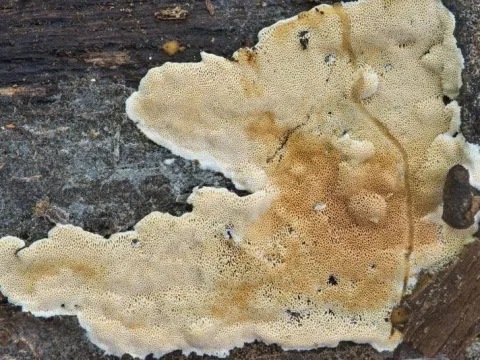
Junghuhnia nitida
Junghuhnia nitida
Junghuhnia nitida is a basidiomycetous fungus belonging to the Polyporaceae family. It is a well-known wood-decay organism that primarily acts as a saprotroph but can behave as a facultative parasite on stressed trees.
What the section contains
Junghuhnia nitida
The pathogen is responsible for causing white rot, a condition where the fungus breaks down both lignin and cellulose in the wood structure, leading to a significant loss of structural integrity.
The life cycle of this fungus involves the production of distinct fruit bodies, which typically appear on the surface of decayed wood or bark as thin, leathery, and often resupinate crusts.
The mycelium of the fungus penetrates deep into the wood tissues, establishing a long-term presence that eventually leads to the formation of visible decay symptoms.
The biological activity of Junghuhnia nitida is highly temperature-dependent, with spore production and mycelial growth peaking during warm and humid weather conditions.
The primary symptom of an infection is the appearance of leather-like or corky fruit bodies on the trunk or branches, characterized by yellowish, cream, or ochre colors.
Upon closer inspection of the infested bark, one might notice white mycelial mats or films underneath, indicating that the fungus has colonized the cambium layer.
Advanced stages of decay are marked by the wood becoming soft, brittle, and acquiring a whitish, bleached appearance, which is a classic indicator of white rot damage.
Affected trees often show signs of overall decline, such as premature leaf drop, dieback of the canopy, and a noticeable reduction in the vigor of the tree.
The structural weakening caused by the fungus often results in localized cracking of the bark and increased susceptibility to snapping or mechanical failure under wind stress.
The development of Junghuhnia nitida is heavily favored by high levels of moisture, both in the environment and within the wood tissue itself, which acts as a nutrient source.
Mechanical injuries, such as pruning cuts, animal damage, or storm-related wounds, serve as major entry points for the fungal spores to colonize the tree's interior.
Trees that are already suffering from environmental stress, such as drought, nutrient deficiency, or overcrowding, are significantly more susceptible to successful fungal colonization.
The accumulation of woody debris and dead branches in the vicinity of healthy trees provides a continuous reservoir of inoculum, facilitating the spread of the pathogen.
Optimal temperatures for spore dispersal and mycelial extension usually coincide with late spring and summer months, making this period critical for infection risks.
The main danger posed by this fungus is the gradual compromise of the tree's internal structure, which eventually leads to tree mortality and loss of structural stability.
Wood colonized by the fungus loses its economic and physical value, making it useless for structural purposes or high-quality timber production due to the extensive rot.
In parks and urban landscapes, infected trees present a significant safety hazard, as they are prone to unexpected failure and falling, which can damage property or cause injuries.
The colonization disrupts the tree's transport system for water and nutrients, leading to chronic malnutrition, reduced growth rates, and the gradual death of the canopy.
Mass outbreaks can lead to the degradation of forested areas, as the pathogen targets weakened specimens, potentially shifting the composition of the local plant community.
Preventative maintenance, including the prompt removal and disposal of infected trees or dead branches, is the most effective way to limit the spread of the fungus.
Care must be taken to minimize wounding of trees during landscaping activities, and any accidental injuries should be immediately treated with appropriate antiseptics.
- Sanitary pruning of infected limbs to prevent further internal spread.
- Maintaining soil health and irrigation to ensure vigorous tree growth.
- Surgical removal of localized fungal infections with disinfection of the underlying wood.
- Eliminating potential breeding grounds by removing fallen wood and debris from the site.
- Monitoring the health of trees during high-risk, warm-weather periods.
For high-value trees, early identification allows for the removal of fruit bodies before they reach the stage of mass spore production, thereby reducing the local infection pressure.
Chemical control via fungicides is generally limited but can be used as a supplementary measure to protect fresh wounds and cuts from primary infection by basidiospores.