
Ash dieback
Hymenoscyphus
The disease is caused by the Ascomycete fungus Hymenoscyphus fraxineus, which is highly aggressive toward common ash and other related species.
What the section contains
Ash dieback
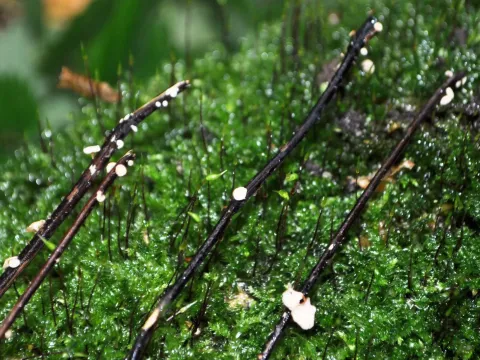
The fungus completes its sexual life cycle on the rachises of fallen ash leaves, where small, cup-shaped fruiting bodies known as apothecia develop.
During the summer months, these fruiting bodies release wind-borne spores that can travel many kilometers, spreading the infection into new areas.
Upon landing, the spores penetrate the leaves and migrate into the twigs and branches, colonizing the host's vascular tissues and sapwood.
This colonization disrupts the flow of water and nutrients, which eventually leads to tissue necrosis and the progressive decline of the tree.
Initial symptoms are characterized by the wilting and darkening of leaves, which often remain attached to the tree during the early stages of infection.
Distinctive diamond-shaped lesions or cankers appear on the bark of twigs and branches, often resulting in the death of the distal parts of the stem.
Trees frequently exhibit epicormic branching, where many small shoots emerge from the main stem, creating a bushy, abnormal appearance.
Internally, the wood beneath the bark lesions appears discolored, typically showing a brownish stain that indicates the presence of the pathogen.
Crown dieback progresses over time, eventually leading to the death of the main branches and, in many cases, the entire tree.
The pathogen thrives in cool, humid conditions, which are highly favorable for spore dispersal and the colonization of new host tissues.
Dense forest stands with poor airflow and high humidity levels facilitate the rapid spread of the disease between neighboring ash trees.
Environmental stressors, such as drought or waterlogging, can weaken trees and increase their susceptibility to the infection.
The abundance of leaf litter on the forest floor provides an ideal substrate for the fungus to persist and produce its infectious spores.
Temperature fluctuations during the summer months play a crucial role in the timing of spore production and the intensity of seasonal outbreaks.
Ash dieback causes massive mortality in ash populations, threatening the survival of the species across its natural European range.
The disease significantly reduces the ecological value of forests, disrupting food chains and habitats for numerous dependent species.
In landscape and urban areas, the presence of infected trees poses a significant safety risk due to the potential for sudden branch or limb failure.
Economic losses are severe, stemming from the costs of tree removal, loss of timber value, and the expense of managing degraded landscapes.
The loss of ash trees can lead to increased soil erosion and changes in the hydrological balance of areas where ash was a dominant species.
Sanitation practices, such as removing heavily infected trees, are essential to reduce the local inoculum load and protect neighboring specimens.
Selecting and breeding ash trees that exhibit natural genetic resistance to the fungus is the most promising long-term solution.
Managing the forest environment to improve air circulation and reduce stand density can help mitigate the severity of the infection.
Restricting the movement of infected plant material and logs is vital to prevent the long-distance spread of the disease into unaffected areas.
- Regular monitoring of tree crown health during the summer.
- Avoid planting ash in high-risk, humid, or sheltered sites.
- Enhancing forest biodiversity to promote ecosystem resilience.