
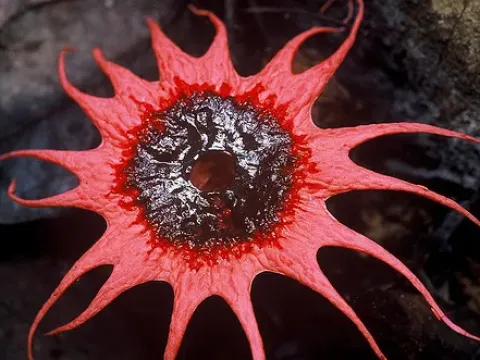
Aseroe rubra
Aseroe rubra
Aseroe rubra, commonly known as the sea anemone fungus or the starfish fungus, is not a plant pathogen or a disease agent. It is a member of the Phallaceae family, primarily classified as a saprotroph.
What the section contains
Aseroe rubra
As a saprotrophic fungus, it derives its nutrients from decaying organic matter, such as dead wood, leaf litter, and rich soil humus. It plays an essential role in the decomposition cycle within forest ecosystems.
The organism grows from an underground mycelium network that colonizes decaying debris. Its life cycle involves the formation of egg-like structures from which the mature fruiting body emerges.
Originally native to tropical regions of the Southern Hemisphere, Aseroe rubra has spread to various temperate climates, often hitchhiking through the global trade of soil, mulch, and potted plants.
Because it does not infect or feed upon living plant tissue, it causes no agricultural damage. Categorizing it as a "plant disease" is a fundamental misconception in botanical studies.
The most distinctive sign of Aseroe rubra is its dramatic mature fruiting body, which features a central disc supported by a stalk and radiating red arms that resemble a sea anemone.
At the center of the disc lies a brownish, olive-colored slimy mass known as the gleba. This substance contains the spores and is responsible for the fungus's characteristic pungent, carrion-like odor.
In its immature state, the fungus presents as a globose, whitish "egg" structure. This stage is often found partially buried in soil, mulch, or leaf litter and is frequently overlooked.
The rapid expansion of the fruiting body, often occurring within just a few hours after a rainfall, is a signature behavioral sign of this species.
The presence of flies or other carrion-feeding insects congregating on the fungus is a secondary indicator, as they are attracted to the spore-bearing slime for food and egg-laying.
This fungus thrives in environments with high humidity and consistent moisture. Periods of heavy rain are the primary catalysts for the emergence of its fruiting bodies.
It prefers nutrient-rich substrates, particularly those containing decaying woody debris or thick layers of organic mulch found in landscaped garden beds.
Temperate and tropical climates provide the best conditions for its survival. Extreme dryness or direct, intense sunlight can desiccate the mycelium and halt the development of new fruiting bodies.
Shaded or semi-shaded areas where the soil remains cool and damp are the most likely places to observe Aseroe rubra growth, as these microclimates protect the mycelium from evaporation.
The spore dispersal process relies heavily on insect activity, meaning that warmer seasons with higher insect populations lead to broader distribution across a garden or habitat.
There is no economic or physiological harm caused by Aseroe rubra to garden plants or crops. It does not compete with plants for mineral nutrients and does not secrete phytotoxic chemicals.
The primary nuisance is the strong, unpleasant odor associated with the mature fruiting bodies, which can be disagreeable if the fungus appears near frequently visited patio areas or entrances.
While the fungus is not harmful to plants, its presence may indicate that a garden bed has overly moist conditions or an excess of unprocessed organic material, which could potentially encourage other pathogens.
The fruiting bodies are not edible and should not be consumed by humans or pets, as they may cause gastrointestinal discomfort if ingested in significant quantities.
Overall, the presence of this fungus is a sign of a healthy decomposition process, and it should be viewed as a beneficial biological agent rather than a pest to be eradicated.
Control measures for Aseroe rubra are generally unnecessary, as the fungus is not a pathogen. The use of fungicides is not recommended and would be ecologically counterproductive.
To discourage growth, focus on cultural practices such as thinning out excessive organic mulch or wood chips. Maintaining a layer of mulch that is not excessively thick helps reduce suitable habitats.
Improving soil drainage is a highly effective way to manage the fungal environment. By preventing water from pooling around plant roots, you create conditions that are less conducive to fungal development.
If the appearance of the fungi is unwelcome, manual removal of the fruiting bodies before they release their spores is a simple and effective physical control method.
Regular weeding and soil aeration help maintain a drier topsoil surface, which prevents the mycelium from surfacing and producing the characteristic starfish-shaped bodies.