
Ash Chanterelle
Cantharellus cinereus
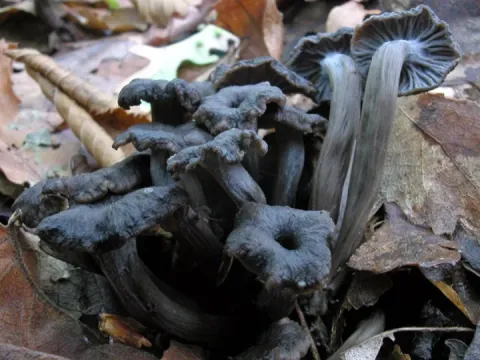
The Ash Chanterelle, scientifically known as Cantharellus cinereus or the "black trumpet," features a distinct funnel-shaped or tubular fruiting body. Its color ranges from dark gray to soot-black, making it difficult to spot against forest debris.
What the section contains
Ash Chanterelle
The upper part of the mushroom is shaped like a deep funnel, which transitions smoothly into a hollow stem. The edges of the cap are often wavy or lobed, giving the mushroom a unique, sculptural appearance.
The underside of the cap is covered in weakly developed folds, or pseudo-gills, that descend far down the stem. Unlike typical gilled mushrooms, these folds are barely visible and share the same color as the cap.
The flesh is thin, brittle, and grayish-brown. When dry, these mushrooms become hard and leathery, but they easily regain their shape and flexibility when moistened by rain.
The fragrance of this mushroom is often described as pleasant, sometimes with fruity or spicy undertones. This aromatic profile is a key identifying characteristic for foragers in woodland environments.
It is critical to note that Cantharellus cinereus is not a plant disease. It is a saprotrophic and mycorrhizal fungus that forms symbiotic relationships with hardwood trees, particularly oak and beech.
Unlike phytopathogens that devastate agricultural crops, this mushroom is an essential component of forest ecosystems. It does not infect or damage plants; rather, it aids in nutrient exchange between the soil and tree roots.
Belonging to the Cantharellaceae family, the fungus plays a significant role in organic matter decomposition. Its life cycle is deeply interconnected with the health of the surrounding forest soil.
The mycelium network permeates the top layers of the soil, assisting in the mineralization of forest humus. This biological activity makes it a beneficial organism rather than a pest or a causative agent of disease.
Categorizing this mushroom as a plant disease is a taxonomic error. As a symbiont, it contributes to forest vitality and is an important part of mycological biodiversity.
The Ash Chanterelle prefers moist, shaded areas within broadleaf forests. It thrives in soils rich in organic matter where decaying leaf litter is abundant and well-established.
Optimal conditions for the emergence of fruiting bodies include periods of consistent rainfall and mild temperatures, typically in late summer and throughout the autumn season.
Human interference in forest environments, such as soil compaction or the removal of leaf litter, can negatively affect the development of the mycelium and the subsequent production of fruiting bodies.
As a mycorrhizal fungus, it requires the presence of healthy host trees. Without a direct connection to the root system of a suitable tree, the fungus cannot complete its lifecycle effectively.
The layer of leaf litter from oak or beech trees serves as a vital micro-environment, maintaining the temperature and moisture levels necessary for the mushroom to grow and disperse its spores.