
Ash rust
Puccinia sparganioides
Description
Symptoms
Initial symptoms appear in late spring or early summer on young leaves and petioles. A primary sign of the disease is the visible deformation, curling, and twisting of infected foliage and twigs.
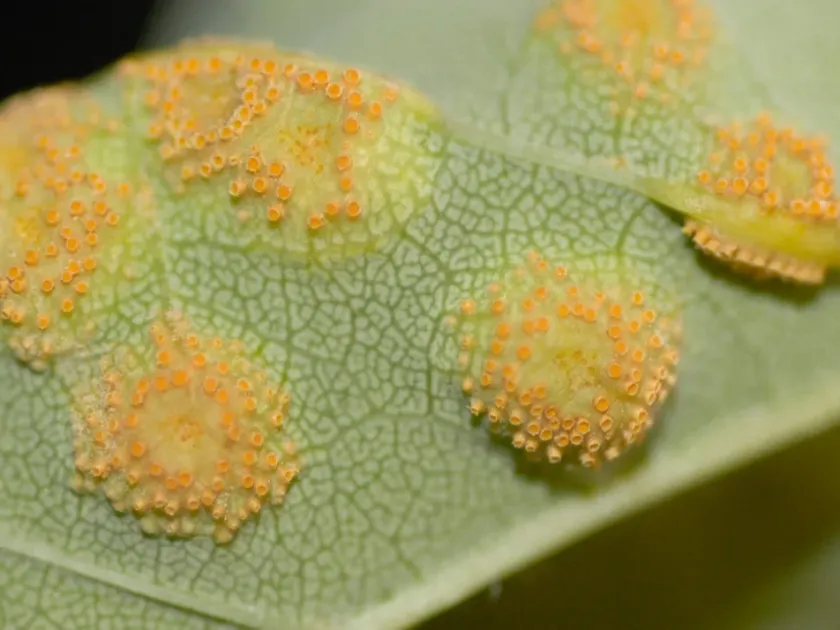
Bright yellow or orange pustules, known as aecia, develop on the undersides of leaves, petioles, and young shoots. These structures release a high volume of aeciospores into the atmosphere.
Affected leaves often turn yellow prematurely, dry out, and drop earlier than usual. Heavy infection can lead to significant canopy damage and a sparse appearance of the tree foliage.
Young shoots may show severe twisting and distorted growth, which is a hallmark symptom of ash rust. In extreme cases, the fungus may cause necrosis of the affected shoots.
As the season progresses toward autumn, the visible signs on the ash tree diminish because the fungus moves to its alternate hosts to complete the next stage of its life cycle.
Pathogen
The causal agent of this disease is the heteroecious rust fungus Puccinia sparganioides. To complete its full biological cycle, the pathogen requires two distinct host plant species.
The primary host is the ash tree (Fraxinus), where the fungus undergoes the aecial stage of development. The alternate hosts are various species of sedge (Carex) and bur-reed (Sparganium), where urediniospores and teliospores are formed.
As an obligate parasite, the fungus extracts nutrients exclusively from living plant tissues. It has evolved complex mechanisms to alternate between its two hosts depending on the season and environmental triggers.
The mycelium typically overwinters in the tissues of the alternate host (sedges), remaining viable throughout the winter season. In the spring, aeciospores are dispersed by wind, infecting young ash leaves and shoots.
The biology of this pathogen is strictly dependent on moisture availability. Rainfall and high humidity are necessary for the spores to germinate and penetrate the host tissue successfully.
Conditions for development
Disease development is favored by cool and wet weather conditions during the spring. Frequent rainfall and fog provide the necessary moisture for spores to germinate on ash tissue.
Proximity of ash plantings to sites with abundant sedge populations significantly increases the risk of infection. Low-lying, wet areas with high sedge density serve as major infection reservoirs.
Dense tree plantings with poor airflow maintain high humidity levels within the canopy, creating an ideal microclimate for the fungus. Prolonged leaf wetness promotes rapid infection.
Wind is the primary vector for long-distance spore dispersal. This makes the disease challenging to manage if sources of infection are present in the surrounding landscape.
Temperatures ranging from 15 to 20 degrees Celsius are considered optimal for the pathogen's activity. Conversely, hot and dry weather conditions tend to inhibit the spread of the fungus.
Why it matters
The primary damage is caused by premature defoliation, which severely disrupts the tree's photosynthetic activity. This reduces the energy reserves stored for the following growing season.
Chronic infection over several years weakens the tree, making it significantly more susceptible to secondary pests, pathogens, and environmental stressors like drought.
In landscaping and urban settings, the deformation of shoots and premature leaf drop reduce the aesthetic value of the trees. This is a critical concern for parks and residential areas.
In forest nurseries, ash rust can cause substantial mortality among seedlings. This results in significant economic losses and impacts the availability of healthy nursery stock.
Weakened trees exhibit slower growth rates and reduced overall vigor. Without intervention, repeated cycles of infection can lead to permanent structural damage to the crown of the tree.
Protection
The most effective preventive measure is the removal of alternate hosts (sedges and bur-reeds) from the vicinity of ash plantings. This breaks the fungal life cycle.
Pruning should be performed to improve air circulation within the canopy. Removing and properly destroying infected branches helps to reduce the local inoculum density for the next year.
In nursery settings, systemic or copper-based fungicides can be used if infection risk is high. Applications should be timed to coincide with leaf bud burst to protect new growth.
Selecting resistant species or cultivars is a recommended strategy for long-term disease management. Always source healthy nursery stock to prevent introducing the fungus to new sites.
Maintaining optimal tree vigor through appropriate fertilization and watering improves the tree's natural resistance to fungal pathogens. Healthy trees recover more efficiently from disease pressure.
Discussion
No discussions yet — be the first.