
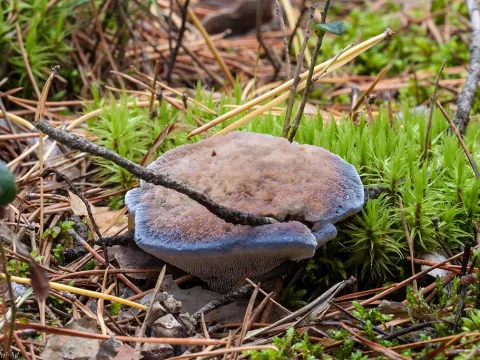
Blue tooth fungus
Hydnellum caeruleum
The Blue tooth fungus, or Hydnellum caeruleum, is a distinctive forest mushroom known for its vibrant blue coloration in its youth. It is often mistaken for a plant pathogen due to its unique, sometimes strange appearance.
What the section contains
Blue tooth fungus
The cap surface is velvety, often displaying radial wrinkles or uneven lobes. A hallmark of the species is the presence of guttation droplets, which look like liquid beads on the surface of the mushroom cap.
The underside of the cap is covered in dense, soft spines that serve as the spore-producing surface. As the mushroom matures, these spines transition from blue to a deep brown color.
The stem is robust, thick, and often encrusted with soil or forest debris. The internal flesh is tough, corky, and does not show any signs of rot or pathological damage commonly seen in plant diseases.
It is important to emphasize that this organism is not a disease of agricultural or horticultural plants. It is a natural biological inhabitant of coniferous forest floors.
Hydnellum caeruleum is not a plant pathogen and does not cause any diseases in crops or trees. It belongs to the family Bankeraceae, which consists primarily of saprotrophic or mycorrhizal species.
The mycelium of the fungus often forms symbiotic relationships, specifically ectomycorrhiza, with the roots of coniferous trees like spruce and pine. This interaction is generally beneficial to the tree.
The fungus does not secrete cellulolytic enzymes capable of decaying living plant tissue. Consequently, it cannot cause wilting, necrosis, or blight in garden plants or trees.
In the context of plant pathology, this organism is irrelevant as it poses zero threat to cultivation. It does not reproduce via infectious plant-to-plant mechanisms.
Scientific consensus classifies this species as an environmentally sensitive fungus that thrives only in balanced, undisturbed forest environments.
The Blue tooth fungus requires specific ecological conditions to fruit, primarily found in mature coniferous forests. It favors areas with thick organic matter and high soil moisture content.
Optimal development of the fruiting body occurs during temperate, humid periods, usually between 12°C and 18°C. It is highly sensitive to temperature fluctuations and drought.
Soil composition is critical; the fungus requires a stable pH and an accumulation of conifer needles. It is often an indicator of long-term ecological stability.
Human activities, such as soil tilling, the use of chemical fertilizers, or deforestation, quickly destroy the environment required for its growth.
Spore dispersal is facilitated by wind, and successful colonization requires a specific microclimate that is typically absent in cultivated agricultural lands.
There is absolutely no harm associated with this fungus regarding agricultural crops. It does not compete with plants for nutrients, nor does it destroy vascular tissues.
Because it is not a parasite, it does not induce systemic infections. Growers and gardeners do not need to worry about crop loss or damage when this fungus is present.
The species lacks the biological machinery required to attack agricultural plants. It remains strictly confined to the soil substrate and forest debris.
No economic damage has ever been attributed to Hydnellum caeruleum in any sector of commercial or private plant production.
It is not a pest, not a pathogen, and should be viewed as a sign of a healthy, functioning forest ecosystem rather than a threat to be managed.
No protective or control measures are necessary because the Blue tooth fungus is not a plant disease. Using fungicides to eradicate it would be ecologically harmful and entirely ineffective.
No prevention strategies are required as there is no infection risk to plants. The best approach is to allow the fungus to remain in its natural habitat.
Should the fungus appear in a garden or park, it should be welcomed as a sign of good soil quality and a healthy environment for conifer trees.
If its physical presence is unwanted in a landscaped area, manual removal is the only action needed. This does not involve chemicals or specialized treatment protocols.
Educating growers that Hydnellum caeruleum is not a pathogen helps prevent the unnecessary and harmful use of chemicals in natural settings.