
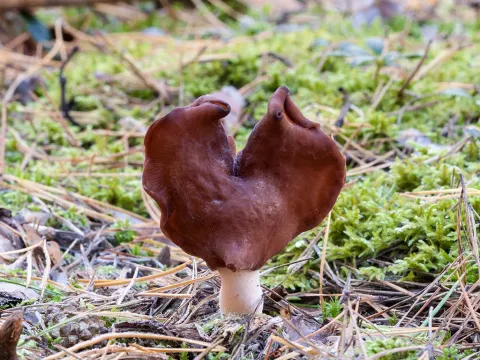
Hooded false morel
Gyromitra infula
The fungus is easily recognized by its distinctive saddle-shaped or lobed cap, which often appears wrinkled and irregular.
What the section contains
Hooded false morel
The color of the cap ranges from reddish-brown to dark chestnut, providing a stark contrast against leaf litter and forest soil.
Its stem is typically pale, sometimes whitish, hollow, and may appear slightly flattened or channeled, giving it a unique profile.
Microscopic inspection of colonized wood reveals white mycelial strands penetrating deep into the cellular structure of the timber.
Fruiting bodies often emerge in small clusters, particularly near decaying stumps or fallen branches in coniferous and mixed forests.
The pathogen is Gyromitra infula, a member of the Ascomycota phylum and the Discinaceae family.
As a saprophytic organism, it specializes in the decomposition of complex lignocellulosic materials found in woody plant debris.
It reproduces through spores released from the cap into the air, which then settle on suitable moist substrates to initiate new colonies.
The fungus secretes enzymes that break down the lignin within the cell walls, significantly weakening the mechanical strength of the wood.
Its life cycle is closely linked to humidity levels, with peak activity occurring during periods of high environmental moisture.
Growth is favored by high humidity and cool to moderate temperatures, which are common in autumn forest environments.
A primary condition for successful establishment is the availability of decaying wood, frequently on conifers or hardwoods.
Shaded, damp sites that retain water for extended periods serve as ideal environments for the spread of Gyromitra infula.
Physical injuries to tree bark create entry points for spores, allowing the mycelium to establish itself within the host tissue.
Prolonged rainy seasons accelerate the sporulation process and facilitate the migration of the fungus across woodland floor debris.
The primary concern is the accelerated decomposition of wood, which can compromise the structural integrity of timber left in the forest.
In managed forestry, it can contribute to the degradation of woody residues, potentially harbor other secondary pests.
The fungus can interfere with the natural recycling of nutrients by altering the chemical composition of decaying organic matter.
Due to the presence of toxic compounds in the fruiting bodies, infested material should never be used for animal feed or mulch.
Infestations are indicative of poor site maintenance, leading to an overall reduction in the quality and value of harvested forest resources.
Effective management requires rigorous sanitation practices, including the removal of deadwood and stumps from the site.
Maintaining adequate site drainage prevents the accumulation of moisture that is essential for fungal colonization and spread.
Protective measures include applying fungicides to freshly cut wood surfaces to prevent spore germination and infection.
Preventative forest management involves protecting live trees from mechanical damage to minimize the risk of pathogen entry.
Early identification of clusters is crucial to prevent the extensive spread of spores and the subsequent degradation of the surrounding wood.