
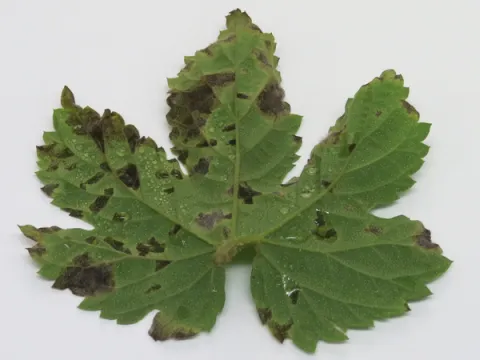
Hop pseudocercospora leaf spot
Pseudocercospora humuli
The first symptoms of the disease appear as small angular spots on the leaves, which are initially brownish or dark gray. Over time, these spots expand, and a characteristic darker margin may develop, indicating progressive tissue necrosis.
What the section contains
Hop pseudocercospora leaf spot
Under high humidity conditions, a sparse, grayish fungal growth becomes visible on the underside of the leaves. This represents the spore-bearing structures (conidiophores) of the pathogen Pseudocercospora humuli.
Severely affected leaves may curl, wither, and eventually drop prematurely. This loss of foliage significantly reduces the photosynthetic capacity of the plant, which is vital for the development of cones during the flowering stage.
The infection can also occur on leaf petioles, leading to structural weakness and premature senescence. If the infection spreads to the stems, it can interfere with the translocation of essential nutrients to the hop cones.
Early diagnosis is crucial, as the disease can easily be confused with other leaf spot pathogens. Microscopic confirmation of the conidia is often necessary to distinguish it from other fungal leaf spotting diseases in hop yards.
The disease is caused by the fungus Pseudocercospora humuli, a specialized plant pathogen that primarily affects hops. It belongs to the class of fungi that reproduce through the formation of asexual conidia.
The pathogen overwinters primarily as mycelium or conidia on infected crop debris left on the soil surface. With the onset of warmer and wetter weather in the spring, the primary inoculum is splashed onto the new growth by rain.
Transmission occurs through the dispersal of conidia via water splashes, wind, and movement within the canopy. The fungus enters the plant tissue mainly through the stomata or wounds on the leaf surface.
Once inside, the mycelium colonizes the mesophyll tissue, destroying cellular integrity and leading to the characteristic spotting. The life cycle can repeat multiple times throughout a single growing season.
The survival strategy of Pseudocercospora humuli is highly dependent on the presence of leaf litter. Effective management of this organic matter is the foundation of preventing recurrent infections year after year.
Development of the disease is highly favored by extended periods of wet, humid weather. Rainfall provides the necessary moisture for the germination of fungal spores on the leaf surfaces.
Optimal temperatures for the fungus range between 18°C and 25°C. In this range, the pathogen exhibits rapid mycelial growth and high sporulation rates, leading to potential epidemics in susceptible hop varieties.
Poor ventilation within the hop yard, often caused by excessively high plant density or overgrown side shoots, prevents rapid evaporation of dew. This prolonged wetness duration is a primary driver for the infection.
Irrigation practices, particularly overhead watering in the late afternoon, significantly increase the risk of disease spread. Such practices keep the leaf surface wet overnight, facilitating spore penetration.
Plants under physiological stress or nutrient deficiencies show increased susceptibility to Pseudocercospora infections compared to robust, well-fertilized crops.
The primary economic harm of pseudocercospora leaf spot is the reduction in both yield and quality of hop cones. Diminished photosynthetic activity directly limits the accumulation of alpha-acids and essential oils.
Premature leaf drop causes an overall decline in plant vigor, which can lead to weakened root systems. This carries long-term consequences, reducing the productivity of the hop yard in subsequent seasons.
The quality of harvested hops may be severely compromised, making the produce less attractive to brewers. Severe infections often require rigorous sorting to remove discolored or necrotic tissues from the yield.
If left unmanaged, the pathogen can cause significant financial losses, potentially reducing total cone output by 20% or more depending on the severity of the growing season's weather.
Secondary infections often take hold in plants already weakened by Pseudocercospora, further complicating the management of the hop yard and increasing the need for additional chemical interventions.
The most effective strategy involves removing the source of the infection. Thorough sanitation, including the removal and destruction of fallen leaves and crop residues after harvest, significantly reduces the initial inoculum.
Cultural practices such as pruning lower leaves and thinning shoots improve canopy ventilation. This allows the foliage to dry out quickly after rain, making it harder for the pathogen to establish itself.
Chemical control involves the application of appropriate fungicides. Timing the application before anticipated periods of wet weather or immediately following the first signs of symptoms is critical for effective control.
Maintaining balanced soil fertility, especially adequate potassium levels, helps the plant build resilient cell walls, providing a level of natural resistance to the fungal infection.
- Regular monitoring of the yard for early symptoms of leaf spotting.
- Application of protective fungicide sprays based on weather monitoring.
- Selection of hop varieties with documented resistance to leaf spot diseases.
- Implementation of proper spacing to facilitate better air movement.