
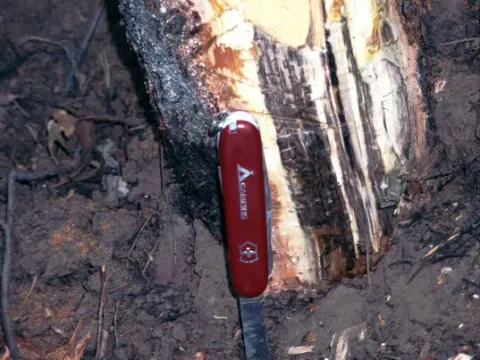
Blue stain of pine wood
Grosmannia leptographioides
The causative agent of this disease is the microscopic ascomycete fungus Grosmannia leptographioides (formerly known as Leptographium leptographioides). This is a wood-staining fungus that primarily attacks the sapwood of coniferous species, especially pine.
What the section contains
Blue stain of pine wood
The fungus belongs to a group that causes deep blue-black discoloration of wood tissues. Its mycelium actively penetrates the tracheids and medullary rays, consuming nutrients stored within the cell cavities.
Vectors of this pathogen are often stem-boring insects, such as bark beetles and wood borers. While boring into the tree, these insects introduce the infection directly into the phloem and sapwood of weakened trees.
The pathogen can develop on both living, weakened trees and freshly cut timber. It does not act as a wood-rotting fungus since it does not decompose lignin or cellulose, but it prepares the substrate for further colonization by mold and decay fungi.
The biology of this pathogen is closely linked to the lifecycle of xylophagous insects, making this disease a significant problem for forest management and the wood processing industry.
The primary external sign of the disease is the appearance of bluish, gray, or gray-black spots on the wood surface. The color intensity varies from light blue to deep navy depending on the stage of infection.
On a cross-section of the log, the damage manifests as radial wedge-shaped patches. These affected areas are clearly defined, contrasting sharply with the healthy wood tissue.
Unlike wood rot, the structure of the wood is not softened during the initial stages of blue stain. The physical density remains largely unchanged, although the material loses its commercial value.
Microscopic analysis reveals dark fungal hyphae filling the cell lumens. Under high humidity conditions, the surface of timber may become covered with a faint gray or blackish fungal mat.
Early-stage infection might be invisible to the naked eye, but the fungus spreads rapidly along the grain of the wood given favorable environmental conditions.
Optimal conditions for Grosmannia leptographioides include a wood moisture content between 25% and 80%. When the moisture content drops below 20%, fungal growth effectively ceases.
Temperature plays a crucial role in development, with the most active growth occurring between +15°C and +25°C. Lower temperatures inhibit growth, but the spores remain viable for long periods.
Poor ventilation during timber storage creates pockets of stagnant air and high humidity, providing an ideal environment for the fungus to spread across lumber stacks.
Freshly cut timber left in the forest during the warm season is at the highest risk of infection due to the presence of bark beetles and direct contact with soil moisture.
Physical injuries to the bark, caused by frost cracks or insect damage, provide easy access for fungal spores to penetrate deep into the sapwood.
The main economic damage is the drastic reduction in timber grade. Stained wood is unsuitable for high-quality joinery, furniture, and structural applications where aesthetics are important.
Blue stain serves as a marker of improper storage conditions. The presence of fungal mycelium increases the hygroscopicity of the wood, causing it to absorb moisture more readily during service.
This infection increases the wood's permeability, making it more susceptible to subsequent colonization by true wood-decaying fungi that degrade strength and structural integrity.
Lumber affected by blue stain cannot be used for products with clear or translucent finishes, as the discoloration remains visible beneath the protective layer.
The timber industry faces massive financial losses as blue-stained wood is frequently rejected in international markets and trade-grade inspections.
The primary prevention method is the prompt transport of timber from the forest during winter and rapid processing. Drying wood to below 20% moisture is the most effective safeguard.
Adequate ventilation within timber piles is essential. Using stickers (spacers) between layers of boards encourages airflow and reduces surface moisture, inhibiting fungal development.
Chemical protection involves treating freshly sawn timber with specialized fungicides/antiseptics that prevent spores from germinating on the surface.
Managing bark beetle populations in forest stands significantly reduces the infection pressure, limiting the number of vectors and spores introduced to the timber.
Kiln drying is a highly effective method to kill the fungus within the wood, stabilizing the material and preventing any further spread of the stain in finished products.