
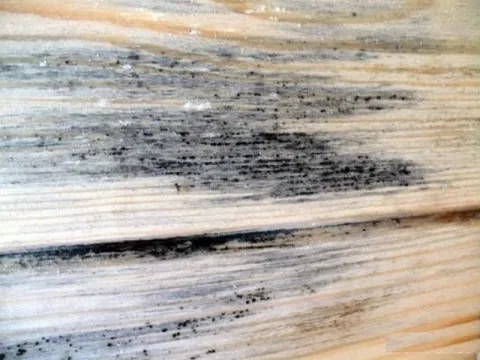
Blue stain fungus
Endoconidiophora coerulescens
The causal agent of this disease is the fungus Endoconidiophora coerulescens, a member of the Ascomycota division.
What the section contains
Blue stain fungus
This fungus is classified as a staining fungus, meaning it consumes the nutrients within the wood cells rather than breaking down the structural cellulose.
The spores of this pathogen are microscopic and lightweight, allowing them to disperse rapidly through the air onto freshly cut surfaces.
Infection primarily occurs via the log ends or through holes made by wood-boring insects, where the fungus finds easy access to the sapwood.
Once inside, the fungal mycelium colonizes the ray cells, which are rich in starch, creating the dark blue pigmentation characteristic of the infection.
The most evident symptom is a characteristic blue-grey or dark black discoloration on the surface and cross-sections of the affected timber.
Depending on the species of wood and the depth of penetration, the intensity of the stain can vary from subtle blue hues to deep black.
Unlike wood-rotting fungi, this condition does not cause immediate structural softening of the wood, which can lead to it being overlooked.
In many cases, the blue stain appears in radial patterns, clearly tracing the movement of the fungus through the wood's nutrient-rich rays.
Affected wood often shows a uniform color change that cannot be removed by simple surface planning or sanding.
The fungus thrives in environments with high moisture levels, specifically when the wood's moisture content is between 30% and 80%.
Optimal temperatures for fungal growth range from 20°C to 30°C, making warm, humid seasons the most high-risk periods for timber production.
Poor ventilation within lumber stacks is a major contributor to the rapid spread of the disease, as it creates stagnant, moist air pockets.
Logs stored directly on the damp ground are highly susceptible to infestation from soil-borne spores and increased moisture uptake.
Any disruption to the bark layer, whether mechanical or biological, acts as a gateway for the fungus to establish itself in the sapwood.
The primary concern is the significant devaluation of lumber, as blue-stained wood is often rejected for high-quality architectural or furniture use.
Stained wood exhibits increased permeability, which makes the material more susceptible to subsequent moisture absorption and decay-causing organisms.
This aesthetic defect poses massive financial challenges for timber exporters who must comply with strict visual quality standards.
Although the mechanical strength of the wood is generally preserved in the early stages, the stain is permanent and lowers the marketability of the product.
The presence of the fungus can also interfere with certain finishes or coatings applied to the wood surface, resulting in poor adhesion or spotting.
The most effective strategy to prevent blue stain is to kiln-dry the lumber rapidly until the moisture content drops below 20%.
Immediate application of fungicidal preservatives to the ends of freshly cut logs is essential to block the primary entry points of the fungus.
Proper stacking with sufficient spacing between layers ensures continuous airflow, which is critical for preventing moisture accumulation.
Sanitation of storage areas, including the removal of infected wood scraps and debris, reduces the overall spore load in the environment.
For long-term protection, especially in hot and humid climates, chemical wood treatments provide a durable barrier against fungal colonization.