
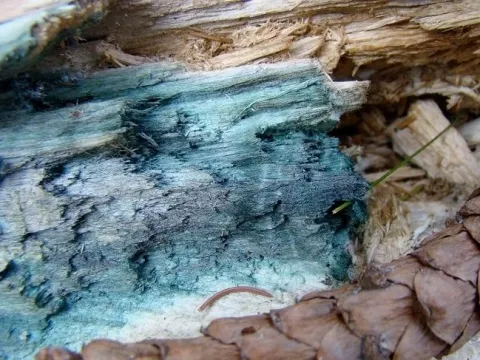
Grosmannia clavigera
Grosmannia clavigera
The fungus Grosmannia clavigera (formerly Ophiostoma clavigerum) is an ascomycete pathogen responsible for the characteristic blue stain in coniferous wood. It is essentially a symbiont of wood-boring bark beetles.
What the section contains
Grosmannia clavigera
The biology of this fungus is intrinsically linked to the mountain pine beetle and related species. The insects transport the fungal spores from tree to tree, while the fungus provides nutritional benefits to the developing beetle larvae.
Once inside the tree, the fungal hyphae colonize the sapwood, primarily targeting the ray parenchyma and tracheids. The fungus releases specific chemical enzymes that break down the plant cell walls.
Grosmannia clavigera thrives within the host's vascular system. It is characterized by its ability to spread rapidly through the xylem, effectively blocking the tree's water-conducting network.
The fungus has a complex reproductive life cycle, including both sexual and asexual (anamorphic) stages, which allows it to persist in various environmental conditions and rapidly infect new hosts.
The most visible symptom of this infection is the discoloration of the wood, appearing as blue, grey, or black streaks. This is commonly referred to as "blue stain" and occurs deep within the timber.
External signs include small entry holes on the bark, created by bark beetles. These sites are often accompanied by "pitch tubes" or frass (boring dust), indicating successful insect colonization.
The foliage of infected trees changes color over time. What begins as a subtle yellowing soon turns into a reddish-brown hue as the tree dies due to the interruption of water transport.
Upon removing the bark, one can observe a distinct dark staining pattern in the sapwood, which often forms a fan-like shape as the fungus spreads inward toward the heartwood.
Advanced stages of the disease manifest as a general decline in the tree's health, characterized by the cessation of resin flow and brittle bark, ultimately leading to total tree mortality.
The development of Grosmannia clavigera is strongly correlated with periods of environmental stress. Prolonged drought conditions weaken the tree’s natural resin defense system, making it vulnerable.
High population densities of beetle vectors are a primary driver for the spread of the fungus. Large-scale outbreaks of beetles often lead to severe and widespread infection of the local pine population.
Temperature plays a crucial role in the growth of the pathogen. Mild to warm conditions, typically between 15°C and 25°C, promote rapid colonization and sporulation of the fungus within the wood.
Poor forestry practices, such as leaving fresh, non-debarked timber in the forest during the peak summer months, provide a perfect breeding ground for both the vector insects and the fungus.
Landscape-level features, including dense, homogenous pine stands, facilitate the rapid expansion of the fungus once an initial outbreak occurs, as the proximity of trees allows for easy transmission.
The economic impact of this fungus is substantial, as it significantly degrades the market value of timber. Blue-stained wood is often rejected for high-quality finishing and structural applications.
In living forests, the fungus acts as a lethal partner to bark beetles, causing the mass death of pine trees. This leads to substantial timber losses and shifts in forest ecosystem dynamics.
Wood structural integrity is compromised once colonized by the fungus. It becomes more prone to moisture absorption, warping, and cracking, which complicates industrial wood processing.
The presence of this fungus accelerates the decomposition process of dead trees, contributing to increased fuel loads and raising the risk of severe forest fire occurrences.
Beyond economic losses, the large-scale death of forests negatively affects biodiversity, as it alters the habitat for various local wildlife species and disrupts ecosystem services.
The primary control strategy involves rigorous sanitation logging. Removing and disposing of infested trees quickly is essential to prevent the emergence of new beetle generations and spore dispersal.
Implementing strict timber management protocols is vital. Ensuring that harvested logs are transported away from the forest or processed promptly during the summer helps disrupt the infection cycle.
Integrated pest management, including the use of pheromone-baited traps, is a standard practice to monitor beetle populations and detect early signs of localized outbreaks.
Enhancing forest resilience through thinning and maintaining appropriate tree spacing can improve individual tree health, enabling them to better withstand both beetle attacks and fungal infections.
In high-value areas, targeted insecticide applications may be used to protect specific trees from beetle colonization, thereby preventing the introduction of the fungus into the host's vascular system.