
Script lichen
Graphis scripta
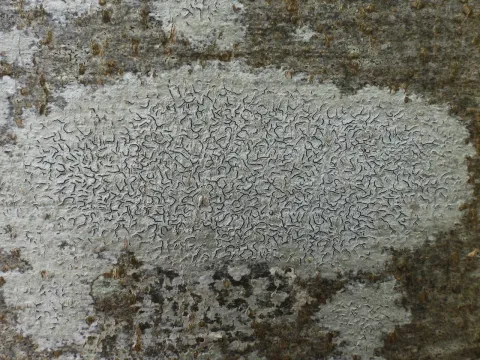
The script lichen (Graphis scripta) is named for its appearance, which resembles ancient writing or cuneiform characters carved into the smooth bark of trees.
What the section contains
Script lichen
These dark, narrow, and winding lines are the apothecia (fruiting bodies) of the fungus, creating a striking contrast against the grayish or white thallus growing on the bark surface.
It predominantly colonizes smooth-barked trees in shaded or humid environments, appearing on the trunks and major branches of mature trees.
Unlike parasitic infections, the thallus remains on the surface and does not cause physical deformation, rot, or deep-seated damage to the tree's vascular system.
Observing these unique patterns on tree trunks is a common occurrence in stable forest ecosystems and well-established, humid garden environments.
Graphis scripta is not a disease-causing pathogen in agricultural terms; it is a symbiotic organism known as a lichen, consisting of a fungus and algae.
The lichen utilizes the tree bark merely as a substrate for physical support, obtaining its moisture and nutrients from the atmosphere rather than the tree itself.
It does not interact with the tree's metabolic processes, meaning it does not act as a parasite, and thus it poses no threat to the health of the tree.
This species is highly valued as a bioindicator of air quality because it is extremely sensitive to pollutants, particularly sulfur dioxide, and vanishes in contaminated areas.
Consequently, the presence of this lichen serves as an environmental indicator of clean air and a stable ecosystem surrounding the orchard or forest stand.
High humidity and consistent shade are the primary conditions required for the colonization and growth of the script lichen on tree bark.
It shows a strong preference for trees with smooth, stable bark surfaces, such as hornbeam, beech, hazel, and sometimes alder, which facilitate spore attachment.
Microclimates with minimal temperature fluctuations and persistent moisture, especially during the spring and autumn seasons, are ideal for its development.
Densely planted orchards or areas with poor crown aeration create a humid microenvironment that supports the expansion of these lichen colonies over time.
The slow-growing nature of the lichen requires the bark surface to remain undisturbed for several years, which is why it is more common on older, mature specimens.
The script lichen is completely harmless to the host tree, as it does not penetrate the bark or consume the tree's photosynthetic energy or nutrients.
There is no physiological impact on the tree's growth, fruit production, or overall vigor, as the lichen is strictly an epiphyte, not a parasite.
While some gardeners perceive any growth on bark as a sign of disease, the script lichen should be viewed as a neutral inhabitant of the tree's surface.
It does not cause bark cracking or tissue necrosis, and its biological presence does not impede the tree's normal seasonal development or respiratory processes.
Consequently, no crop yield reduction or tree longevity issues have been associated with the presence of this specific lichen species in agricultural settings.
There is no agricultural requirement for controlling the script lichen, as it does not constitute a plant disease or a threat to commercial production.
If aesthetic preferences dictate the removal of lichens from trunks, simple mechanical cleaning with a soft brush during the dormant season is sufficient.
Improving airflow and sunlight penetration within the tree canopy through pruning can naturally reduce the moisture levels required for lichen colonization.
Maintaining the overall health and vigor of the trees through balanced fertilization and proper water management is a sufficient preventive approach.
Chemical applications, such as fungicides, are not recommended, as they are unnecessary and ineffective against lichen colonization on healthy bark.