
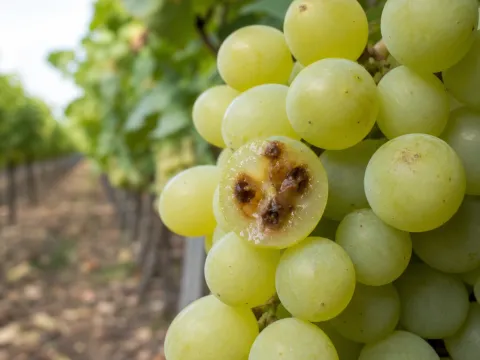
Grapevine berry internal necrosis
Grapevine berry
Grapevine berry internal necrosis manifests as the browning of tissues inside the berry, which often remains hidden during initial visual inspections. As the fruit matures, affected berries may take on a dull appearance, and the skin often loses its natural turgor.
What the section contains
Grapevine berry internal necrosis
When the berry is cut open, necrotic patches are clearly visible within the flesh, exhibiting dark brown to black coloration. Unlike fungal rots, these internal necrotic zones are typically dry and lack the characteristic odors of fermentation or mold.
The necrosis can affect individual berries within a cluster or impact a significant portion of the total yield, substantially reducing the marketability of the produce. Symptoms are most pronounced during the full maturation stage, immediately prior to harvest.
In certain instances, the condition is accompanied by the breakdown of vascular tissues within the pedicel, leading to the premature shriveling of individual berries. Over time, the necrotic tissues can expand to occupy most of the berry's interior.
External signs can vary depending on the grape variety, but the primary diagnostic factor remains the localization of damage within the berry flesh, while the outer skin may appear deceptively intact in the early stages.
Grapevine berry internal necrosis is classified as a physiological disorder rather than an infectious disease. This means that its development is not triggered by fungi, bacteria, or viruses.
The primary driver of this condition is the disruption of metabolic processes within berry tissues during periods of intensive swelling and maturation. The disorder emerges as a plant response to environmental stress factors.
Biologically, the necrosis is caused by an impairment in the transport of water and nutrients to the berry, leading to localized cell death under conditions of metabolic imbalance. Deficiencies in specific micronutrients or poor water management are frequent contributors.
Unlike true pathogens, this necrosis cannot be transmitted between vines through mechanical contact. The cause is always a combination of the variety's genetic predisposition and specific site-related cultivation conditions.
The systemic nature of the disruption indicates that the core issue lies within the plant's own physiology, which fails to maintain normal berry tissue function when faced with specific stress-inducing environments.
Key conditions favoring the development of this disorder include sharp fluctuations in temperature and soil moisture during critical berry growth stages. The period of active berry filling is particularly vulnerable, as the plant's demand for nutrients is at its peak.
Imbalanced mineral nutrition, particularly deficiencies in calcium and magnesium, significantly increases the risk of necrosis. Excessive nitrogen application also promotes this pathology by encouraging vigorous shoot growth at the expense of proper fruit development.
Soil and climate factors, such as high soil acidity or poor aeration of the root system, create conditions that impede the transport of micronutrients to vegetative organs and clusters.
Prolonged drought followed by heavy rainfall triggers unstable water uptake, leading to cell rupture or internal tissue death due to sudden changes in osmotic pressure within the berries.
Agronomic errors, such as failing to thin the crop load, exhaust the vine, making it less resilient to physiological deviations as the berries mature.
The primary economic harm is the substantial loss of fruit quality, rendering the yield unsuitable for the fresh produce market. Berries with internal necrosis lose their organoleptic appeal and are unsuitable for long-term storage.
When a large portion of the crop is affected, the economic viability of the vineyard drops to critical levels. Producers are often forced to discard entire clusters, which drastically reduces the net yield.
The condition negatively affects the quality of wine must, as necrotic tissues can become sites for secondary microbial colonization. This leads to spoilage of the must and a degradation of the final product's quality.
Internal necrosis often serves as an indicator of serious shortcomings in vineyard management, necessitating costly revisions to soil nutrition programs and irrigation systems.
The total loss from this disorder is difficult to estimate early, as the hidden nature of the condition is often discovered only during sorting or transportation, thereby increasing logistical and operational costs.
The primary control measure is the optimization of the vineyard's nutrition program, focusing on the application of chelated calcium fertilizers. Timely foliar applications help strengthen berry cell walls.
- Maintaining stable and consistent irrigation throughout the maturation period.
- Ensuring a balanced supply of macro- and micronutrients in the soil.
- Implementing quality pruning to avoid vine overcropping.
- Selecting grape varieties that are resilient to physiological stress.
Monitoring and managing soil pH, including liming where necessary, is essential. Providing adequate root zone aeration through regular inter-row cultivation also facilitates better nutrient uptake.
It is vital to monitor vine health throughout the entire growing season, as prevention is always more effective than attempting to treat necrosis once the physical damage has occurred near harvest.
The use of biostimulants that improve plant stress tolerance can help reduce the grapevine's sensitivity to adverse environmental fluctuations.