
Grapevine fanleaf
Grapevine fanleaf
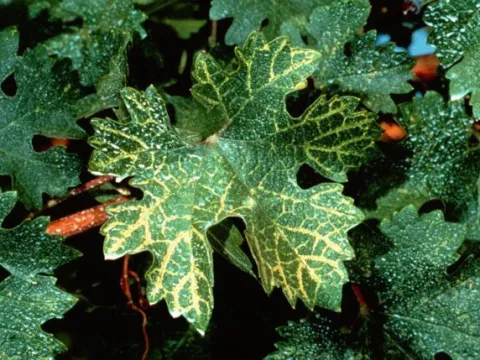
The most distinctive symptom is the leaf deformity, which appears as fan-shaped leaves with asymmetrical blades and sharply serrated margins. This look is the reason for the common name.
What the section contains
Grapevine fanleaf
The shoots exhibit stunted growth with shortened internodes, often resulting in double nodes or multiple branches. Flattened, ribbon-like shoots (fasciation) are also a common sight in severely infected vines.
During the flowering stage, the infection causes significant flower and fruit set abortion. This leads to sparse, straggly clusters and an uneven berry size, a phenomenon often called shelling or poor set.
Infected vines lose their vigor over time, showing reduced shoot growth and poor canopy development. The plants become stunted and lose their ability to sustain productive growth.
The fruit quality is severely compromised, with delayed and uneven ripening of berries, making the harvest unsuitable for quality winemaking or fresh market consumption.
The disease is caused by the Grapevine fanleaf virus (GFLV), a member of the genus Nepovirus. It is a spherical, positive-sense single-stranded RNA virus.
The virus primarily affects Vitis vinifera cultivars and rootstocks. It colonizes the host systematically, residing in the vascular tissues and root systems, which makes it impossible to cure.
The primary vector of the virus is the soil-borne dagger nematode, Xiphinema index. These nematodes transmit the virus from infected roots to the roots of healthy, adjacent grapevines.
The virus also spreads through human activity, specifically the use of infected vegetative propagation material like cuttings or grafted vines, allowing it to cover long distances.
Grapevine fanleaf causes long-term economic damage by reducing yield capacity significantly. It forces premature vineyard removal, which is a major financial loss for growers.
The cumulative effect of the disease weakens the vine's resistance to cold temperatures and drought, often causing entire vineyard blocks to fail within a few years of initial symptoms appearing.
Prevention is the only viable management strategy. Growers should strictly use virus-indexed nursery stock produced through tissue culture to ensure the vines are clean from the start.
If an infection is identified, the standard procedure is to remove the vines, including the entire root system, and allow the land to lie fallow for several years to eliminate the nematode population.
Soil fumigation and the use of resistant rootstocks can help manage the population of Xiphinema index in areas where the virus has been historically present.