
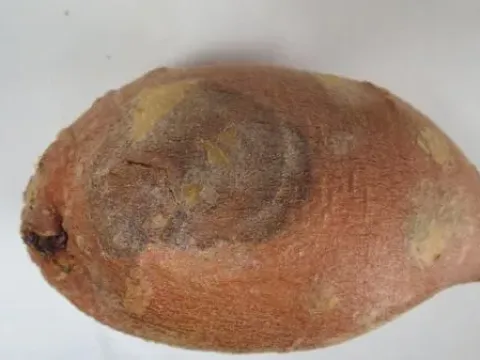
Fusarium wilt of sweet potato
Fusarium bataticola
The first symptom is the chlorosis and yellowing of the lower leaves, which gradually spreads to the younger foliage of the plant.
What the section contains
Fusarium wilt of sweet potato
As the disease progresses, the vines begin to wilt and fail to recover even after irrigation, indicating severe vascular damage.
A cross-section of the stem or the crown reveals dark brown discoloration of the vascular tissues caused by fungal invasion.
The root system may show signs of decay, often turning dark and brittle as the infection kills the feeder roots.
In advanced cases, the tubers may become spongy or develop internal cavities filled with the white or pink mycelium of the pathogen.
The causal agent is the soil-borne fungus Fusarium bataticola, which colonizes the plant's internal vascular system.
The fungus produces hardy chlamydospores that can persist in the soil for several years even in the absence of a host crop.
Infection primarily occurs through root wounds caused by insect damage, nematodes, or mechanical handling during transplanting.
Once inside, the pathogen blocks the xylem, preventing the translocation of water and essential nutrients to the upper parts of the plant.
The fungus also secretes harmful phytotoxins that trigger leaf yellowing and accelerate the premature senescence of the vines.
Optimal development of Fusarium wilt occurs in warm soil conditions, specifically within the temperature range of 25°C to 30°C.
High soil moisture levels facilitate the germination of fungal spores and enable the rapid colonization of the sweet potato root system.
Poorly aerated soils and inadequate drainage create an environment where the fungus can thrive and spread more efficiently.
Repeated cropping of sweet potatoes on the same land without rotation significantly increases the fungal inoculum density in the soil.
Excessive use of nitrogenous fertilizers can also make plants more susceptible to the infection by promoting succulent, vulnerable growth.
The primary economic impact is a significant yield loss due to plant stunting, wilt, and reduced tuber development.
The quality of the tubers is severely compromised, leading to storage rot and marketability issues after harvest.
Land infected with Fusarium bataticola remains a long-term threat, restricting the farmer's ability to plant sweet potatoes in the future.
The disease can cause total crop failure in highly infested fields, causing substantial financial losses for growers.
Secondary infections often exacerbate the damage, as weakened plants are more susceptible to other soil-borne rot organisms.
Strict crop rotation using non-host plants for at least 3 to 5 years is the most effective way to break the disease cycle.
Always utilize disease-free certified sprouts or slips to ensure that no inoculum is introduced into clean soil.
Improve soil drainage and aeration to reduce the conditions that favor the proliferation of the fungal pathogen.
Implement proper sanitation by removing and destroying symptomatic plants, including their root systems, immediately upon detection.
- Treating planting slips with approved fungicides to prevent early infection.
- Managing nematode populations that facilitate fungal entry into roots.
- Using composts enriched with beneficial microbes like Trichoderma.
- Monitoring fields for early signs of yellowing to contain potential outbreaks.
- Maintaining soil pH levels that are less favorable for Fusarium growth.