
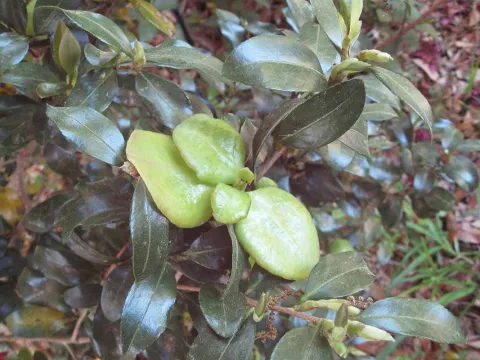
Exobasidium camelliae
Exobasidium camelliae
The most distinctive symptom of this disease is the development of abnormal, fleshy swellings and galls on young leaves and shoots.
What the section contains
Exobasidium camelliae
Initial infection appears as pale or yellowish-green spots on the foliage, which eventually thicken and puff up.
A white, powdery layer often develops on the underside of the infected tissue, representing the fungus's active sporulation.
As the disease progresses, the galls may turn pink or reddish, becoming increasingly firm and wax-like in texture.
Severely affected leaves eventually curl, become distorted, and drop prematurely, leading to thinning of the plant canopy.
The pathogen responsible is Exobasidium camelliae, a fungus that specifically parasitizes plants belonging to the genus Camellia.
The fungus colonizes the intercellular spaces of the plant tissue, triggering cellular hypertrophy and hyperplasia that form the characteristic galls.
The pathogen's life cycle is synchronized with the new growth phase of the host, as it primarily targets tender, developing leaf tissue.
Spores are disseminated by wind currents and splashing water, allowing the fungus to spread rapidly during wet, cool weather.
The fungus survives the off-season as mycelium within infected buds or as spores in plant debris near the base of the shrub.
High relative humidity is the critical environmental driver for the development and spread of Exobasidium camelliae.
The disease is most prevalent in cool, damp spring weather when the host is producing new, susceptible growth.
Poor air circulation, often caused by overcrowding or dense foliage, creates a microclimate that facilitates fungal spore germination.
Overhead irrigation, especially during late afternoon, leaves foliage wet for extended periods, significantly increasing the risk of infection.
Low light levels and poor soil drainage contribute to reduced plant vigor, making camellias more susceptible to this fungal pathogen.
The primary impact of the disease is the severe loss of aesthetic value, as the galls and leaf deformation ruin the plant's appearance.
Heavy infections lead to significant defoliation, which reduces the plant's photosynthetic capacity and weakens its long-term health.
Young plants or newly established shrubs may suffer from stunted growth or shoot dieback if the infection is not managed properly.
Repeated annual infections can exhaust the plant's reserves, making it susceptible to secondary stressors like drought or pests.
Commercial nurseries face economic losses due to the unsaleable quality of infected stock and the costs associated with disease management.
Effective management begins with the immediate removal and disposal of all infected galls and shoots to reduce the source of inoculum.
It is crucial to collect and destroy all fallen leaf litter from the soil surface to prevent the pathogen from overwintering.
Prophylactic applications of copper-based fungicides during the early spring growth flush can effectively protect healthy tissue from infection.
Improving the cultural environment, such as spacing plants correctly to improve air circulation, is vital for long-term disease control.
- Regular pruning of infected branches.
- Avoidance of overhead irrigation.
- Application of systemic fungicides if necessary.
- Maintaining plant vigor through proper fertilization and watering.