
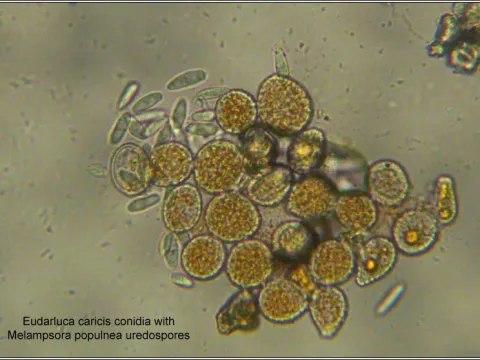
Eudarluca caricis
Eudarluca caricis
Eudarluca caricis is a species of fungus known primarily as an obligate hyperparasite that thrives on the mycelia and spores of various rust fungi (Pucciniales).
What the section contains
Eudarluca caricis
It does not attack the tissues of crop plants directly; instead, it targets the reproductive structures of the rust fungi responsible for severe plant diseases.
The fungus produces small, dark-colored perithecia, which are often found embedded within or on top of the uredinia or telia of the rust host.
Biologically, it plays a complex role in the ecosystem, serving as a natural regulator of rust populations on various agricultural and wild grasses.
The discovery and study of this organism are significant for researchers exploring biological control options for cereal rusts.
The proliferation of Eudarluca caricis is intrinsically linked to the presence and severity of rust infections in the field.
High relative humidity, frequent dew, and moderate temperatures are the most critical factors favoring the growth and spread of this hyperparasite.
It typically becomes most active during the middle to late stages of the growing season when rust colonies have established themselves on the host plants.
The fungus overwinters through its perithecia on crop residues, allowing it to persist in the field from one season to the next.
Dense crop canopies that trap moisture create an ideal microclimate for E. caricis to effectively colonize rust pustules.
Eudarluca caricis is considered a beneficial organism in agricultural systems rather than a harmful pathogen.
By consuming the spores of rust fungi, it reduces the inoculum potential and limits the secondary spread of rust diseases within a crop.
It is not known to cause any damage to the physiological processes or yield capacity of commercial cereal crops such as wheat, barley, or rye.
The presence of E. caricis is often an indicator that the rust pathogen has reached a stage where natural antagonism is occurring.
Farmers can view its presence as a natural suppression mechanism that helps maintain the balance of the field ecosystem.
No specific control measures are necessary for Eudarluca caricis as it does not pose a threat to agricultural productivity.
In fact, excessive use of broad-spectrum fungicides may unintentionally harm populations of this beneficial fungus, potentially leading to increased rust levels.
Integrated Pest Management (IPM) strategies should focus on managing the rust pathogen itself rather than attempting to control its natural hyperparasite.
Maintaining healthy field conditions and using rust-resistant varieties are the best practices for overall disease management.
- Utilize rust-resistant cultivars to reduce the primary rust host population.
- Ensure proper crop residue management to minimize overwintering sources.
- Avoid unnecessary chemical fungicide applications that could disrupt natural biocontrols.
- Monitor disease dynamics to distinguish between damaging pathogens and natural antagonists.