
Dothiora canker
Dothiora ribesia
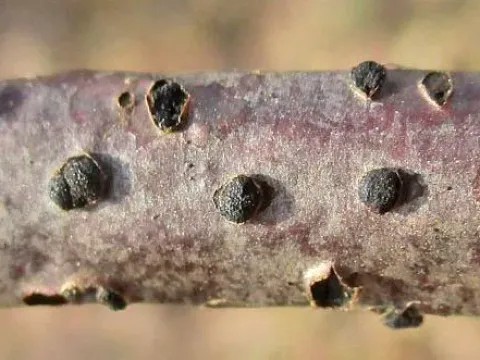
The primary and most visible symptom of this disease is the appearance of specific spots on the bark of one-year-old and older currant canes.
What the section contains
Dothiora canker
Numerous small, black eruptions form on the affected bark areas, which represent the fruiting bodies of the fungus.
As the disease progresses, the infected bark gradually cracks and dies, leading to the drying out of individual branches or entire bushes.
Leaves on infected branches may turn yellow, curl, and fall off prematurely, which significantly weakens the plant before the winter period.
With severe infection, necrosis of the cambium is visually observable, which prevents normal sap flow and healthy bud development.
The causative agent of this disease is the ascomycete fungus Dothiora ribesia, which follows a parasitic lifestyle.
The fungus belongs to the Dothideomycetes class and mainly affects the bark and woody tissues of plants in the Grossulariaceae family.
The infection persists as mycelium and spores within the tissues of dead currant shoots for long periods.
The pathogen is spread primarily through ascospores, which are released into the atmosphere when environmental conditions are favorable.
The biology of the fungus is closely tied to weakened plant tissues, through which it penetrates the shoot to develop an intracellular mycelial network.
The main factor promoting the development of Dothiora canker is high air humidity and frequent rainfall during the spring and summer.
The fungus actively develops in dense plantings where normal air circulation is obstructed and moisture tends to stagnate.
Bark injuries resulting from frost, sunscald, or mechanical damage provide entry points for the fungal infection.
Weakening of bushes due to mineral nutrient deficiencies or improper maintenance significantly increases the risk of rapid disease spread.
Prolonged periods of cool and rainy weather create an ideal environment for the germination of fungal spores on the bark of berry bushes.
Dothiora canker causes significant damage to currant plantations by provoking the premature drying of productive shoots.
A reduction in the plant's photosynthetic surface due to leaf fall leads to a sharp decrease in berry yield.
The infection of perennial branches with mycelium makes them brittle, which can lead to breakage under the weight of the harvest or snow cover.
Accumulation of infection on a site without proper control can lead to the total death of a bush over several growing seasons.
The quality of commercial production declines as infected bushes develop small, poorly formed fruits with low flavor characteristics.
The primary method of control is regular sanitary pruning and the immediate removal of infected branches, followed by burning them.
It is important to manage planting density, thinning out bushes in a timely manner to ensure proper aeration and light penetration to the inner canopy.
To prevent infection, it is recommended to apply prophylactic treatments with copper-based fungicides in early spring and autumn.
Strict adherence to agronomic practices is necessary to provide plants with balanced nutrition, which enhances their immunity to fungal diseases.
When the first signs of the disease are detected, it is advisable to use systemic fungicides that are approved for use on berry crops.