
Dothiora canker
Dothiora maculans
The causative agent of the disease is the ascomycete fungus Dothiora maculans. In the pathogen's life cycle, spores play a key role, spreading via wind, rain droplets, and insects to infect weakened plant tissues.
What the section contains
Dothiora canker
The fungus primarily follows a saprotrophic or weakly parasitic lifestyle, but under favorable conditions, it can actively develop on living shoots. Its mycelium penetrates the bark and cambial layer, disrupting normal metabolism and plant nutrition.
Infectious material persists on affected branches, fallen leaves, and bark residues for a long time. Due to its high adaptability, the fungus can overwinter even in harsh conditions, activating during the first spring thaws.
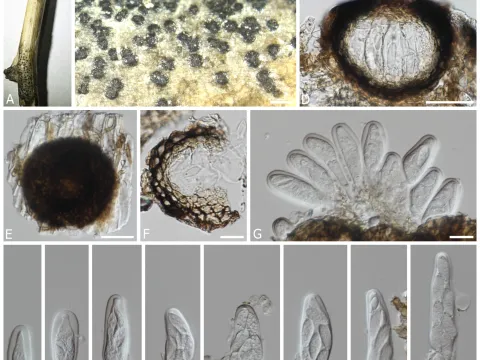
The developmental cycle includes the formation of fruiting bodies (apothecia) where ascospores mature. These ascospores are the primary source of infection for young shoots in spring, entering through micro-cracks or lenticels.
Diagnosis of the pathogen requires laboratory investigation, as in the early stages, the mycelium may be hidden under layers of dead bark. Microscopic analysis reveals characteristic conidia and ascospores specific to Dothiora maculans.
The main signs of the disease are localized areas of necrosis on the bark of young branches. Affected areas turn brown or dark, gradually sinking to form visible depressions against the healthy bark.
As the pathogen develops, the bark in the affected areas begins to crack, exposing the underlying tissues. This creates favorable conditions for secondary infection by other pathogenic fungi and bacteria.
During the sporulation period, small dark bumps can be seen on the surface of the affected bark. These are the fruiting bodies of the fungus, which can release spore mass in the form of a slimy coating under high humidity.
Leaves on infected branches often yellow and drop prematurely. In severe cases, the entire branch may wither because the fungus encircles the shoot, blocking the transport of nutrients from roots to the canopy.
A characteristic sign is patchiness: the disease rarely affects the entire plant at once, appearing as local "spots" of dying bark, which visually resemble burns or mechanical injuries.
Development of Dothiora canker is favored by high humidity conditions, especially prolonged spring rains. Moisture is a necessary factor for spore germination and subsequent penetration into host tissues.
Weakening of the plant due to low temperatures (frost cracks) or drought significantly increases the susceptibility of crops to this pathogen. Healthy and vigorous plants have natural defenses against this fungus.
The temperature range optimal for mycelium development is within moderate limits. The pathogen tolerates heat poorly, which is why disease outbreaks are more frequently recorded during cool, damp seasons.
Densely planted orchards and lack of canopy ventilation create a microclimate with stagnant air and high humidity. This is a critical factor contributing to the rapid spread of spores throughout the orchard.
Lack of mineral nutrition and improper pruning that leaves large wounds also provoke active colonization of the bark by Dothiora maculans.
The primary danger lies in the gradual dieback of branches, leading to a decrease in overall productivity of fruit crops. The progressive loss of the canopy leads to a reduction in the photosynthetic area.
Infected trees become extremely vulnerable to winter cold. Tissues damaged by the fungus lose their elasticity and resistance to freezing, often leading to the death of the entire plant.
Economic damage consists of costs for additional protective measures and loss of fruit marketability when the tree's general condition is compromised. In nurseries, the disease can lead to the culling of the entire planting stock.
The disease can spread from infected plants to neighboring healthy ones, creating foci of epiphytotics in orchards. Ignoring symptoms leads to the rapid spread of the infection to adjacent plots.
Prolonged infection weakens the plant's immunity, making it highly attractive for colonization by wood-boring pests, which ultimately accelerates the tree's demise.
The foundation of prevention is regular sanitary pruning and removal of affected branches. All cuts should be treated with wound paint or copper-based antiseptics to prevent spore penetration.
Application of copper-based fungicides and other contact preparations in early spring before bud break helps reduce the infection pressure. Treatments should be carried out according to specific crop regulations.
It is important to ensure an optimal nutritional regime, especially the application of potash fertilizers, which increase bark resistance to pathogens. Nitrogen fertilizers should be dosed to avoid excessive growth of tender tissues.
Prevention of mechanical damage and proper sealing of frost cracks help minimize the number of entry points for the infection. The use of high-quality bark treatment agents is mandatory.
- Regular monitoring of bark condition.
- Maintaining spacing during planting for canopy ventilation.
- Collection and destruction of fallen leaves and infected shoot residues.
- Disinfection of garden tools after working with affected plants.