
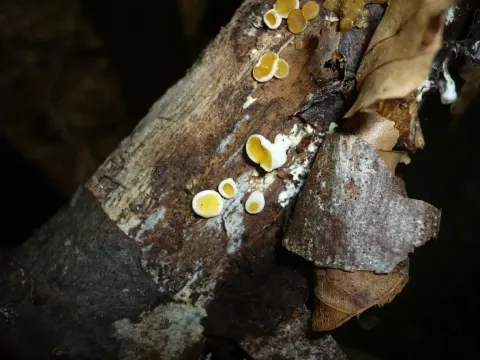
Ditiola peziziformis
Ditiola peziziformis
The external signs of infection by this pathogen are characterized by the development of distinct fruit bodies on the surface of the bark or decaying wood. These structures typically have a disk-like or cup-shaped appearance.
What the section contains
Ditiola peziziformis
The coloration of these fruiting bodies ranges from bright yellow to vibrant orange. Under high humidity conditions, they become gelatinous or jelly-like, making them highly visible against the dark bark of the host tree.
During dry weather, the fruiting bodies shrink and turn brownish, often becoming difficult to distinguish from the substrate. They frequently appear in clusters near cracks, injuries, or on dying branches.
Infection is often localized in areas where the tree has experienced bark damage, such as frost cracks or insect activity, which serve as entry points for the fungal mycelium.
Visual identification is most reliable during damp periods, when the fungus is active and the fruiting bodies expand to their full, characteristic shape, providing a clear indication of the presence of the pathogen.
The causative agent is the fungus Ditiola peziziformis, which belongs to the Ascomycota division. It is recognized as a wood-decaying organism specialized in the degradation of lignin and cellulose components.
This pathogen is commonly associated with coniferous tree species, where it colonizes weakened or dead wood, acting as an opportunistic parasite or a primary wood-rot decomposer.
The life cycle involves the formation of spores, which are easily disseminated by wind currents and water droplets, allowing the fungus to quickly spread to adjacent vulnerable tree tissues.
The fungus is capable of surviving for long periods within the wood tissue in the form of mycelium, allowing it to withstand harsh environmental conditions and resume active growth when favorable weather returns.
As a pathogen, it exploits tree vulnerabilities, thriving in environments where the host's natural defenses are compromised by mechanical damage or physiological stress.
High relative humidity is the primary prerequisite for the development and spread of this fungus. Prolonged periods of rain or fog facilitate the growth and sporulation of the fruiting bodies.
While the fungus can adapt to a range of temperatures, it exhibits the most vigorous growth during temperate periods with sufficient moisture. Excessive heat and aridity can inhibit its development.
Mechanical damage to the bark is a critical factor for infection. Any breach in the tree's protective surface creates an ideal environment for the fungus to establish its mycelium within the inner tissues.
Dense planting schemes with poor air circulation significantly increase the risk of infection, as stagnant air traps moisture, creating a microclimate that is perfect for fungal growth.
The presence of woody debris and deadfall in the vicinity serves as a persistent reservoir for the pathogen, ensuring a high spore load that threatens the health of nearby healthy trees.
The primary damage caused by this fungus is the destruction of wood structure, which leads to a significant loss of structural integrity in trunks and branches, increasing the risk of breakage.
In commercial forestry, the presence of Ditiola peziziformis reduces the commercial value of the timber, as the wood becomes brittle and structurally compromised, rendering it unsuitable for quality construction.
Infection often leads to the premature dieback of individual branches, which diminishes the tree's overall vigor and significantly reduces its aesthetic value in landscape and park settings.
Continued colonization can eventually weaken the entire tree, making it susceptible to secondary infestations by insects and other pathogens, ultimately leading to the total decline or death of the host.
The economic impact is compounded by the costs of sanitation measures, such as the selective removal of diseased trees to prevent the further spread of the fungus throughout the forest stand.
The primary control measure is rigorous garden and forest sanitation, which involves the timely removal and destruction of infected branches and wood, ideally by burning, to eliminate the source of spores.
Maintaining optimal tree health through proper irrigation and nutrient management is essential, as healthy trees possess stronger natural defenses against fungal invasions.
All mechanical injuries and pruning wounds should be promptly treated with professional-grade fungicidal pastes or wound sealants to prevent the ingress of fungal pathogens.
Thinning out dense plant clusters to improve airflow is a highly effective preventative strategy, as it ensures that bark surfaces dry out quickly after precipitation.
Chemical control using systemic fungicides may be considered in high-value plantations, but it should always be implemented as a supplement to, not a replacement for, sound horticultural and silvicultural practices.