
Desarmillaria root rot
Desarmillaria
The disease is caused by the fungus Desarmillaria tabescens, formerly known as Armillaria tabescens. It is a persistent soil-borne pathogen that belongs to the Physalacriaceae family.
What the section contains
Desarmillaria root rot
Unlike other honey fungi, it does not possess a ring on the stipe. The fungus spreads through the soil by forming rhizomorphs—dark, shoestring-like structures that seek out host roots and initiate new infections.
The fungus acts as both a saprophyte and a parasite, surviving on dead wood and eventually attacking healthy roots. It colonizes the cambium and xylem, effectively girdling the tree at the root collar level.
It attacks a diverse range of host plants, including pome fruits, stone fruits, grapevines, and various ornamental trees. It is particularly lethal to plants already stressed by environmental conditions.
This pathogen can remain active in the soil for years, feeding on organic debris, which makes it a challenging threat to long-term orchard management and plantation health.
Early symptoms include premature yellowing of leaves, leaf drop, and stunted shoot growth. Often, the tree appears water-stressed even when the soil moisture is sufficient.
A diagnostic sign is the presence of white, fan-shaped mycelial mats under the bark near the root collar. These mats often emit a distinctive, earthy mushroom scent when freshly exposed.
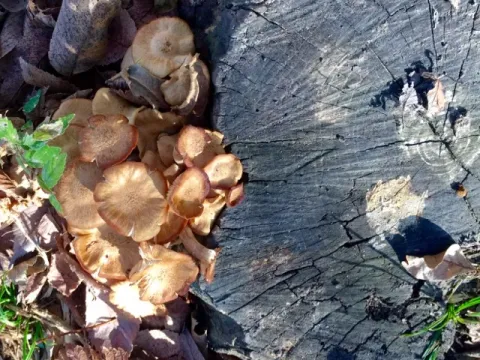
During late summer and autumn, clusters of honey-colored mushrooms appear at the base of the infected tree. Their lack of a ring on the stalk is the primary field identifier for this specific species.
The wood under the bark of infected roots often shows signs of white rot, becoming soft and discolored with distinct dark lines running through the decaying tissue.
As the infection progresses, the entire root system may decay, causing the tree to lose anchorage and potentially topple over during periods of high wind or heavy rain.
The fungus thrives in poorly drained, waterlogged soils. Excess moisture creates an environment that favors the rapid elongation of rhizomorphs and the successful infection of host tissues.
Mechanical damage to roots or stems, often caused by improper cultivation or lawn mower impact, serves as an entry point for the fungus to establish itself within the host.
Environmental stress, such as prolonged drought, freeze damage, or attacks by secondary pests, significantly reduces a tree's resistance, making it an easy target for Desarmillaria.
Temperature plays a crucial role, with optimal growth occurring between 18°C and 25°C. In such conditions, the rhizomorphs extend aggressively to contact neighboring healthy root systems.
The presence of old stumps or buried organic debris provides the necessary energy source for the fungus to persist and build up its infectious biomass in the orchard environment.
Desarmillaria root rot is highly destructive, frequently leading to the total loss of trees within an orchard. It creates irreversible damage that necessitates tree removal and disposal.
The infection results in significant yield reduction. Fruit quality decreases as the tree shifts its resources from production to survival, leading to smaller fruit sizes and premature drop.
The pathogen is capable of spreading through root-to-root contact, which can result in the rapid formation of large infection patches, causing widespread mortality throughout the planting.
Economic losses include the cost of clearing infested sites, sanitizing the soil, and the long-term inability to use the affected land for replanting susceptible fruit crops.
Trees that manage to survive the initial infection remain weakened, becoming more susceptible to other pests and diseases, which eventually necessitates premature replacement of the crop.
Management begins with strict sanitation: remove all infected trees along with as much of the root system as possible. Burn or dispose of the woody debris away from the planting site.
Isolate the infected area by digging deep trenches around the affected zone to prevent the spread of rhizomorphs to healthy trees. This is a critical step in containing the pathogen.
Prior to replanting, ensure the soil is cleared of all woody remnants. Improving soil drainage and aeration can significantly lower the risk of future infection and discourage fungal growth.
Utilize biological control agents, such as Trichoderma species, which can compete with and antagonize the pathogen, helping to restore microbial balance in the soil.
- Regular inspection of root collars for early detection.
- Copper-based fungicidal drenches as a preventative measure for non-infected neighbors.
- Maintaining optimal tree vigor through balanced fertilization and proper irrigation.
- Avoiding mechanical injury to the base of the trees.
- Selecting resistant or less susceptible rootstocks for new plantings.