
Destroying angel
Amanita virosa
Description
Symptoms
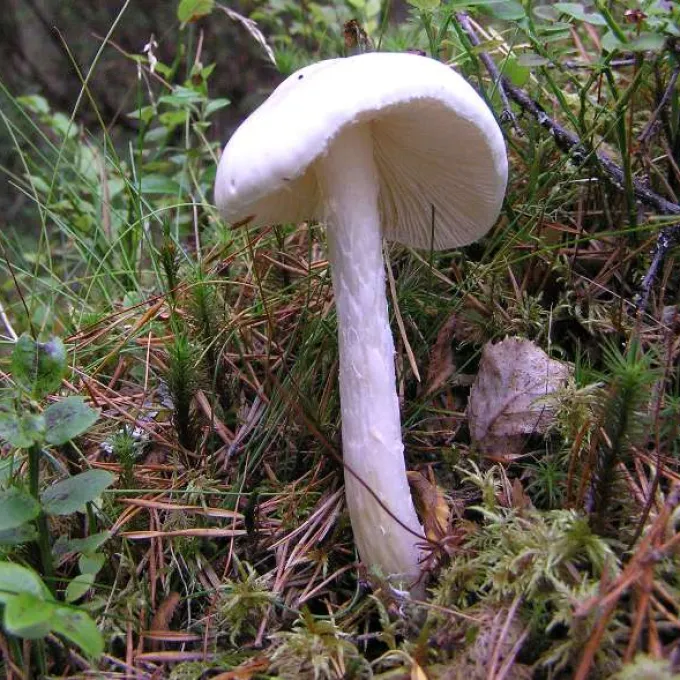
The most distinctive feature of the destroying angel is its pure white appearance, which remains consistent throughout the mushroom's lifecycle.
The cap typically starts conical or bell-shaped, eventually flattening out, though it may remain slightly asymmetrical as it fully matures.
A persistent white ring is usually present on the stem, accompanied by a sac-like structure called a volva at the base, which is often partially hidden in the soil.
The stem surface often exhibits a delicate, flocculent, or scaly texture, which serves as a key identifying characteristic for mycologists.
A foul, unpleasant smell, often compared to chlorine or rotting organic matter, is another hallmark that distinguishes this fungus from edible lookalikes like button mushrooms.
Pathogen
Amanita virosa, commonly known as the destroying angel, is a species of deadly mushroom within the Amanitaceae family. It is vital to state that this fungus is not a plant disease pathogen.
The fungus functions as a mycorrhizal symbiont, living in a mutually beneficial relationship with the root systems of various forest tree species.
It helps trees acquire water and soil nutrients, playing a significant role in the health and growth of natural forest ecosystems.
From an agronomic perspective, it does not infect, parasitize, or damage any crops, fruits, or vegetables used in commercial agriculture.
Its biological presence is limited to forest floors, where it helps cycle nutrients as a decomposer and a symbiont, rather than causing any agricultural blight.
Conditions for development
The destroying angel thrives in moist, shaded forest areas that feature rich, acidic soil and abundant decaying organic matter.
Fruiting bodies typically appear from late summer through autumn, coinciding with periods of high humidity and moderate temperatures.
It is commonly found in coniferous and mixed forests where the mycorrhizal network between the fungus and the host trees remains active.
Spore dispersal relies on air currents and insects, allowing the fungus to establish itself successfully across diverse forested landscapes.
The growth and survival of the fungus are highly dependent on the stability of the forest environment, particularly the health of the host trees it associates with.
Why it matters
The primary danger posed by the destroying angel is its extreme toxicity to humans and animals; consumption results in severe liver and kidney damage.
The mushroom contains lethal amatoxins, which are heat-stable and cannot be neutralized by cooking, drying, or other common food preparation methods.
There is zero harm to agricultural output, as the species lacks any parasitic mechanism that would enable it to infect commercial crops.
For agricultural workers, the risk is strictly limited to accidental ingestion, making it a safety hazard rather than an agricultural production threat.
Its presence near farm boundaries or wooded areas of a property requires no intervention, as it poses no risk to plants, livestock, or agricultural equipment.
Protection
No specialized control measures or fungicides are required for the destroying angel, as it does not affect agricultural yield or plant health.
Proactive safety measures should focus on educating staff about the risks of foraging for mushrooms in wooded areas near agricultural sites.
If the fungus appears near recreational zones on a property, physical removal of the fruiting bodies can prevent potential accidental contact by personnel.
The application of chemicals is strictly discouraged, as it would destroy the local mycorrhizal balance and harm the surrounding forest vegetation.
The most effective management strategy is to treat the mushroom as a non-threatening part of the local ecosystem that requires no agricultural intervention.
Discussion
No discussions yet — be the first.