
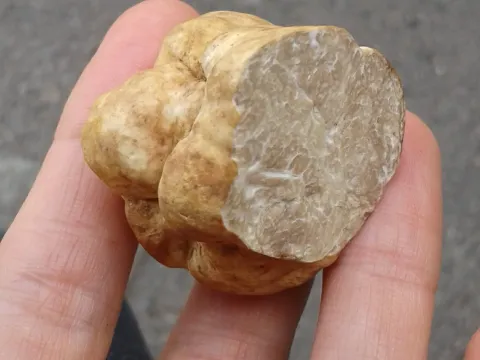
Desert truffle
Terfezia
Terfezia is not a plant disease or a pathogen; it is a genus of fungi belonging to the Terfeziaceae family, commonly known as desert truffles.
What the section contains
Desert truffle
These organisms are strictly mycorrhizal, meaning they establish a symbiotic, mutually beneficial relationship with the roots of certain vascular plants.
The fungus provides the plant with essential nutrients and water, especially in nutrient-poor desert soils, in exchange for sugars produced by photosynthesis.
They do not invade the plant's vascular system, nor do they cause tissue necrosis or wilting, which are hallmarks of true plant diseases.
Because they form subterranean fruiting bodies that can resemble root abnormalities, they are sometimes misidentified as pests or pathogens during field inspections.
Terfezia species are adapted to arid and semi-arid environments, particularly in regions across North Africa, the Middle East, and parts of Southern Europe.
They thrive in sandy, alkaline soils with low moisture content where traditional fungi are unable to survive due to extreme drought conditions.
The development of the fungus is highly dependent on the presence of specific host plants, typically species within the Cistaceae family.
Rainfall patterns act as a critical trigger for the development of fruiting bodies, as moisture facilitates the expansion of the mycelial network.
The fungal spores are exceptionally heat-resistant and can remain dormant in the soil for extended periods until environmental conditions become favorable.
Terfezia causes no damage to crops and should not be treated as a threat to agricultural productivity in any region.
On the contrary, the mycorrhizal association can improve plant stress tolerance by enhancing water uptake in sandy, arid farming conditions.
Economic losses only occur when farmers incorrectly identify the fungus as a disease and apply unnecessary, costly chemical treatments.
There is no evidence of competitive exclusion where this fungus harms the host plant's development or nutrient uptake efficiency.
In fact, the presence of such symbiotic fungi is often an indicator of a healthy, biologically active soil ecosystem in native desert habitats.
As Terfezia is not a plant disease, there are no control protocols or protective measures required to manage or eradicate it.
Should the fruiting bodies be considered a nuisance, simple physical removal during soil tillage is the only necessary action.
The use of chemical fungicides to combat this organism is strongly discouraged, as it disrupts beneficial soil microbial life and adds unnecessary chemical load.
Effective management focuses on correct biological identification to distinguish between beneficial mycorrhizal fungi and actual soil-borne pathogens like nematodes.
Maintaining soil structure and promoting healthy organic matter decomposition are the best ways to manage fields where these symbiotic fungi may naturally occur.