
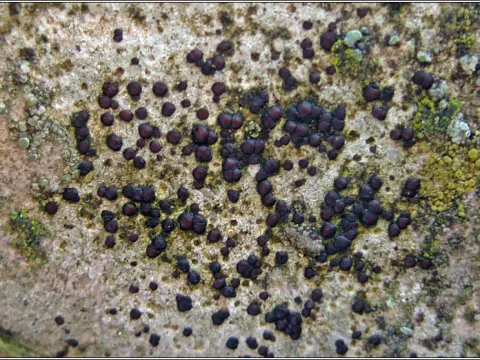
Clauzadea
Clauzadea
Clauzadea is a genus of crustose lichens that are frequently misidentified as plant diseases due to their appearance on tree bark.
What the section contains
Clauzadea
These organisms form a thin, crust-like layer that adheres tightly to the surface of the bark, often showing a cracked or granular texture.
The thallus color usually ranges from gray to brownish, featuring small, dark, and sometimes sunken apothecia (fruiting bodies).
Visual inspection reveals that the growth remains superficial and does not cause necrosis, decay, or deformation of the plant tissue.
Unlike true pathogens, Clauzadea does not penetrate the cambium layer or interfere with the plant's vascular system.
Biologically, Clauzadea is not a plant pathogen but a symbiotic organism composed of a fungus and an alga (a lichen).
It occupies the surface of the bark solely for structural support, utilizing the host plant as a substrate rather than a source of nutrients.
In agronomy, it is often grouped with epiphytic flora that colonizes mature, slow-growing, or stressed woody plants.
The classification of this genus depends on complex mycological features, such as the structure of spores and reproductive bodies.
There is no infectious process involved; the presence of Clauzadea is a result of ecological succession on the bark surface.
The development of Clauzadea is heavily influenced by high humidity levels and stable environmental conditions in orchards or forests.
Poor ventilation and dense canopy cover create an ideal microclimate for the colonization of bark surfaces by these lichens.
They prefer surfaces with slow bark exfoliation, which is typical for older trees or those with compromised vitality.
As lichens are sensitive to air pollutants, their presence often indicates good local air quality and ecological stability.
Shaded sides of tree trunks are the most common locations where these crustose lichens establish their colonies.
Clauzadea causes no direct economic damage to crops, as it lacks parasitic capability and does not affect plant productivity.
Its presence is primarily an aesthetic issue and a bio-indicator of the plant's growth rate rather than a sign of a disease epidemic.
While minimal, there is a slight risk that dense lichen cover could shelter pest larvae or insects during their overwintering period.
The superficial layer of the lichen does not restrict gaseous exchange to a degree that would impact the tree's physiological processes.
No agricultural chemical control is required, as the organism poses no threat to the commercial value of the crop.
Management of Clauzadea is focused on physical maintenance rather than the use of fungicides, as it is not a pathogen.
Mechanical removal using soft scrapers or brushes can effectively clean the bark surface if aesthetic concerns arise.
Applying traditional lime-based whitewash to trunks is a standard practice that helps sanitize the bark and discourage lichen growth.
Pruning and canopy management are highly effective preventive measures that improve airflow and light penetration.
Maintaining overall tree vigor through appropriate fertilization and water management makes the bark less suitable for lichen colonization.