
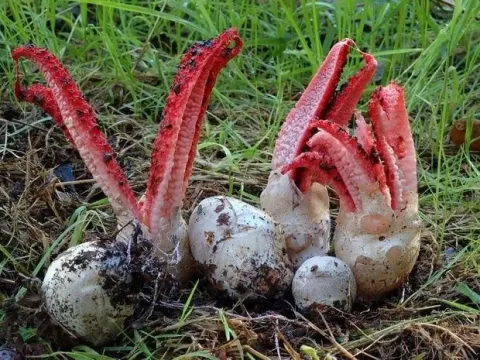
Clathrus archeri
Clathrus archeri
Clathrus archeri, commonly referred to as the Octopus Stinkhorn or Devil's Fingers, is a saprotrophic fungus from the Phallaceae family rather than a parasitic plant disease.
What the section contains
Clathrus archeri
It acts as a decomposer, feeding on dead organic matter such as decaying wood, mulch, and leaf litter in the soil environment.
The fungus originates from Australia and New Zealand and has become an invasive species in various parts of Europe and North America.
Its life cycle involves a mycelial network in the soil that produces egg-like structures, which later erupt into distinct, tentacle-like fruit bodies.
Because it does not attack living plant tissue, it is not considered a pathogen that poses a direct threat to agricultural or horticultural crop health.
The fungus begins its visible stage as white or grayish, leathery spheres or "eggs" partially buried in the soil or organic debris.
Upon maturation, the outer layer breaks, revealing four to eight bright red, arm-like segments that resemble octopus tentacles.
These arms are covered in a dark, olive-green slime known as gleba, which contains the spores and emits a strong, foul odor similar to rotting carrion.
This odor is a primary diagnostic feature, as it serves to attract flies and other insects that help disperse the fungal spores.
The fruit body typically collapses and decomposes rapidly within a few days after the gleba has been removed by insects or weather.
Clathrus archeri thrives in moist, shaded environments, particularly in areas rich in decomposing organic matter such as wood chips and bark mulch.
It prefers high humidity and thrives during periods of consistent rainfall or in areas where irrigation maintains consistently damp soil conditions.
The fungus often establishes itself in woodland margins, garden beds, and areas around tree bases where organic debris accumulates.
Warm summer temperatures, coupled with sufficient moisture, accelerate the development of the fruit bodies from the subterranean mycelium.
It is frequently observed in gardens that utilize organic mulching materials, which provide a ready food source for the fungal hyphae.
The fungus is ecologically beneficial as it helps break down organic waste; it does not harm living plants, crops, or lawns directly.
The primary concern for gardeners is the significant aesthetic impact and the offensive, foul odor that can be unpleasant near residential areas.
The presence of large numbers of flies attracted to the fungus may be an nuisance, although the flies themselves do not directly damage plants.
In some contexts, the appearance of this fungus indicates excessively damp conditions or an over-accumulation of decomposing wood debris in the soil.
There is no evidence that Clathrus archeri transmits plant pathogens or interferes with the nutrient uptake of garden plants.
Control measures are strictly optional and primarily involve mechanical removal for aesthetic purposes or to reduce the local fly population.
Removing the egg-stage fungi before they burst can help prevent the release of spores and the subsequent development of the foul-smelling fruit bodies.
Improving soil drainage and thinning out excessive organic mulch can help create an environment less favorable for the fungus to fruit.
There is no necessity for chemical fungicides, as they are ineffective against the underground mycelium and unnecessary for the health of the garden.
- Regular inspection of mulched areas.
- Manual removal of eggs and fruit bodies.
- Reducing mulch layer thickness.
- Improving landscape drainage.